Antiquarianism in Seventeenth-Century England: John Aubrey and Surrey
John Aubrey (1626–97) was considered by himself and others to be a virtuoso, pursuing biographical, antiquarian, mathematical, scientific, and other interests, often combining or switching between the subjects as he pleased, both in his personal life and his writing. Aubrey was born to a well-established family of moderate wealth as the eldest of three surviving sons in Wiltshire, and attended school locally as a young child, first at his own church for grammar school, and then to Leigh Delamere, the next parish.[1] After this, his further academic pursuits were curtailed by the civil war and personal matters, and when his father died in 1652, Aubrey inherited his debts, which would only be the first of his legal troubles. Aubrey had two major marriage prospects that ended in death and legal disputes that drained the rest of his assets, respectively. No longer living the wealthy life that he was accustomed to, Aubrey became a travelling scholar in 1671, and lived off various patrons and friends.[2] Many of these associates Aubrey likely either met or became close to through the Royal Society, which Aubrey himself became a member of in 1663. In his personal life, he was charming, yet known to be a bit of a gossip. This suited him well, however, when it came to writing Brief Lives, a biographical collection on Aubrey’s contemporaries. Aubrey wrote the Brief Lives over the course of many years, as he tended to write most of his works, and rather than presenting formal biographies, he recorded anecdotes, personal observations, and oral testimony.[3] Although these accounts sometimes contain inaccuracies or unverified stories, they are regarded as key primary sources because they preserve details unavailable elsewhere.
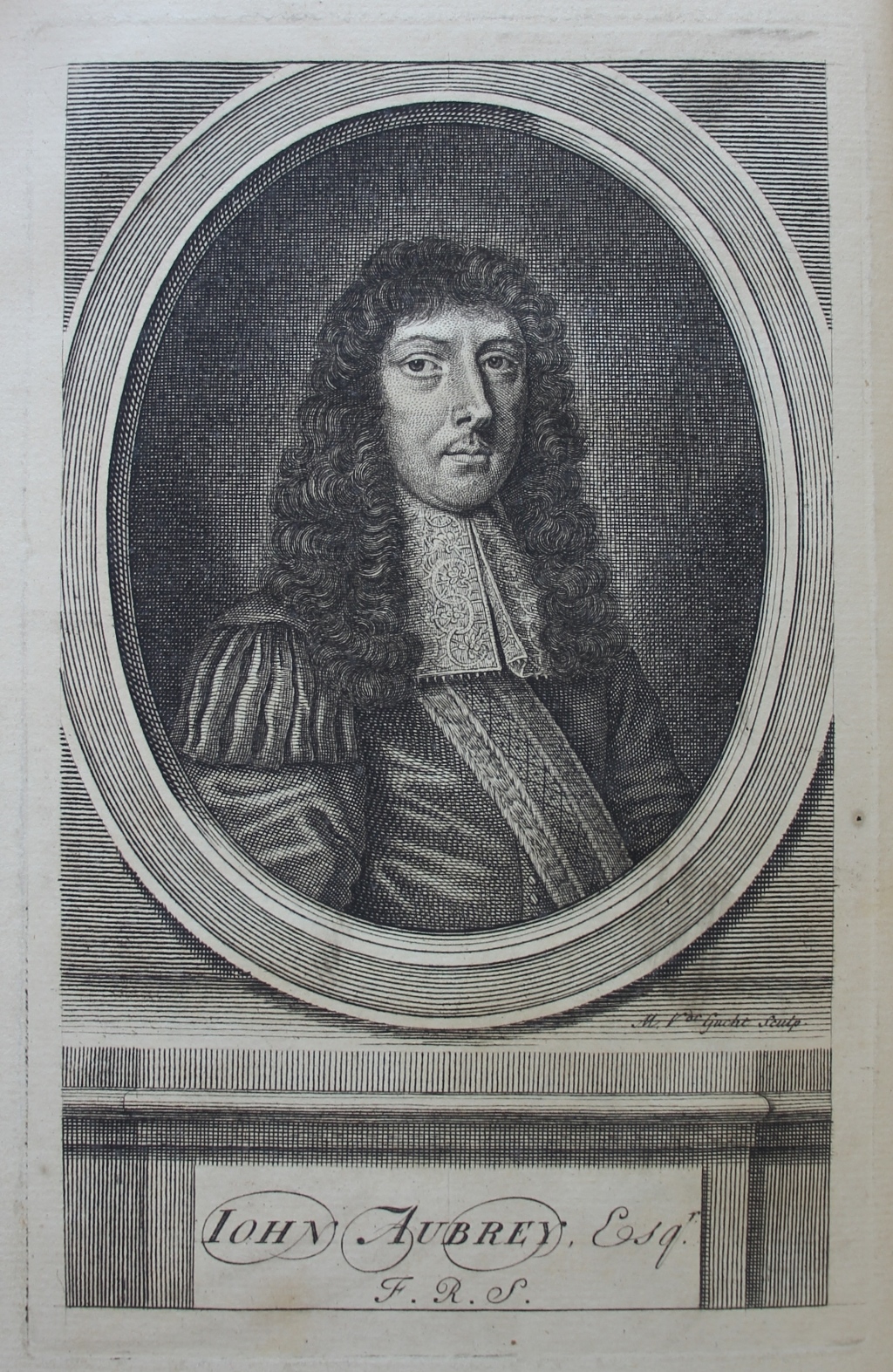
John Aubrey, The natural history and antiquities of the County of Surrey… 5 vols (London, 1718), i, frontispiece. A portrait of John Aubrey.
Throughout his schooling and the rest of his young life, Aubrey witnessed old manuscripts and documents being used as essentially scrap paper and rags, which upset him greatly. Aubrey believed that all manuscripts, and all written works as a broader category, had an inherent worth, and should be preserved and studied instead of carelessly discarded.[4] This principle is directly tied to Sir Francis Bacon’s (1600–63) ideals about philosophy and naturalism, as he believed that the way in which the author wrote about the subject was part of the knowledge, and thus every paper could add something valuable in how it conveys the same information.[5] Aubrey would have reason to take on Baconian principles, as the early Royal Society was focused on realizing Bacon’s idea of experimental science.[6] As Aubrey was first and foremost an antiquarian, he also prioritized the preservation of papers as a means of historical research. After all, antiquarianism is significantly easier when there are records and texts left to study and refer to. Aubrey himself insisted upon his own notes and manuscripts being preserved, and he had them sent to the Ashmolean Museum at Oxford, founded by his close friend Elias Ashmole (1617–92).
In addition to Aubrey’s views on preserving manuscripts, he also had a unique and eclectic writing style that is reminiscent of an unedited train of thought where he absolutely refuses to leave out information. From one sentence to the next, Aubrey will jump from describing a monument in a churchyard, to how tall he suspects the church is, to a rumour about a man in town, to inserting a passage from Ovid that he deems important enough to interrupt the chapter.[7] This in itself is Baconian, not in the writing style itself, but in Aubrey’s refusal of anything to be lost to time or an overzealous edit. However, it can at times make for a challenging and hard-to-follow read, and Aubrey’s unwillingness to cut anything or even significantly edit his works made him an unattractive choice for publishers.
In May of 1671, Aubrey was commissioned by John Ogilby (1600–76) to complete a survey of the county of Surrey, and Aubrey ended up in Surrey to take on the project in July of the same year. This survey was intended by Ogilby to be a small piece of a much larger work containing the entirety of Britain. However, when Aubrey sent Ogilby what he had written, Ogilby insisted that he edit it down to a fraction of the original size, seemingly not having realized what a survey of that scope entails. In late 1673, Ogilby eventually decided to not use Aubrey’s work at all, which Aubrey was extremely upset by.[8] To start, he had lost his employment and not received the payment that he was promised, which put him once again at the mercy of debt collectors. Additionally, the Surrey work had turned into a bit of a passion project for Aubrey, and he was devastated to find out that it wouldn’t be seeing the light of day after all.[9] In the preface to the published version, John Evelyn (1620–1706) writes a letter to Aubrey detailing his support for the work and his own family lineage, which was élite within Surrey. Evelyn himself was the close friend of Henry Howard (1628–84), sixth duke of Norfolk, and inherited one of his estates when he died.[10] Evelyn, known today for his diary and gardens, seemed to have been charming and well-liked, evidently having ties to every prominent family in the area. Evelyn gave his support and information to Aubrey, and a comprehensive family tree of the Evelyns is included as a foldout in the published version. Aubrey worked on the project intermittently until 1691, when he submitted it with the rest of his manuscripts to the Ashmolean Museum for safekeeping.

John Aubrey, The natural history and antiquities of the County of Surrey… 5 vols (London, 1718), i, a map of Surrey.
The content of what eventually became The Natural History and Antiquities of the County of Surrey illustrates Aubrey’s dedication to the Baconian principle of knowledge taking precedence over almost everything else. At his own admission, this meant sacrificing brevity and sensible ordering in order to keep the astounding amount of information. This makes a defining characteristic of the work is its interdisciplinary breadth. Instead of conceiving of Surrey as simply an administrative or political unit, Aubrey presents the county as a complex historical landscape in which natural features, archaeological remains, architecture, genealogy, customs, and social memory combine to reveal the development of human society over time. His account is therefore concerned not merely with recording historical events, but with detailing the cultural and material identity of place.
Aubrey spends much of the work focused on built structures as a physical history. He regarded architecture, monuments, grave inscriptions, and archaeological remains as forms of documentary evidence capable of preserving information that written or oral records alone could not provide. Throughout the text he records the dimensions, appearance, condition, and location of churches, manor houses, castles, ancient structures, and gravestones with remarkable precision, often noting architectural alterations or evidence of decay. These observations reflect his awareness that physical monuments were vulnerable to neglect and destruction, and that their careful documentation constituted an essential aspect of historical preservation, which expands upon Bacon’s notion of written work being historical record and thus valuable. His descriptions frequently seek to establish relationships between surviving material remains and the documentary record, allowing architecture to function as evidence for broader historical continuity.
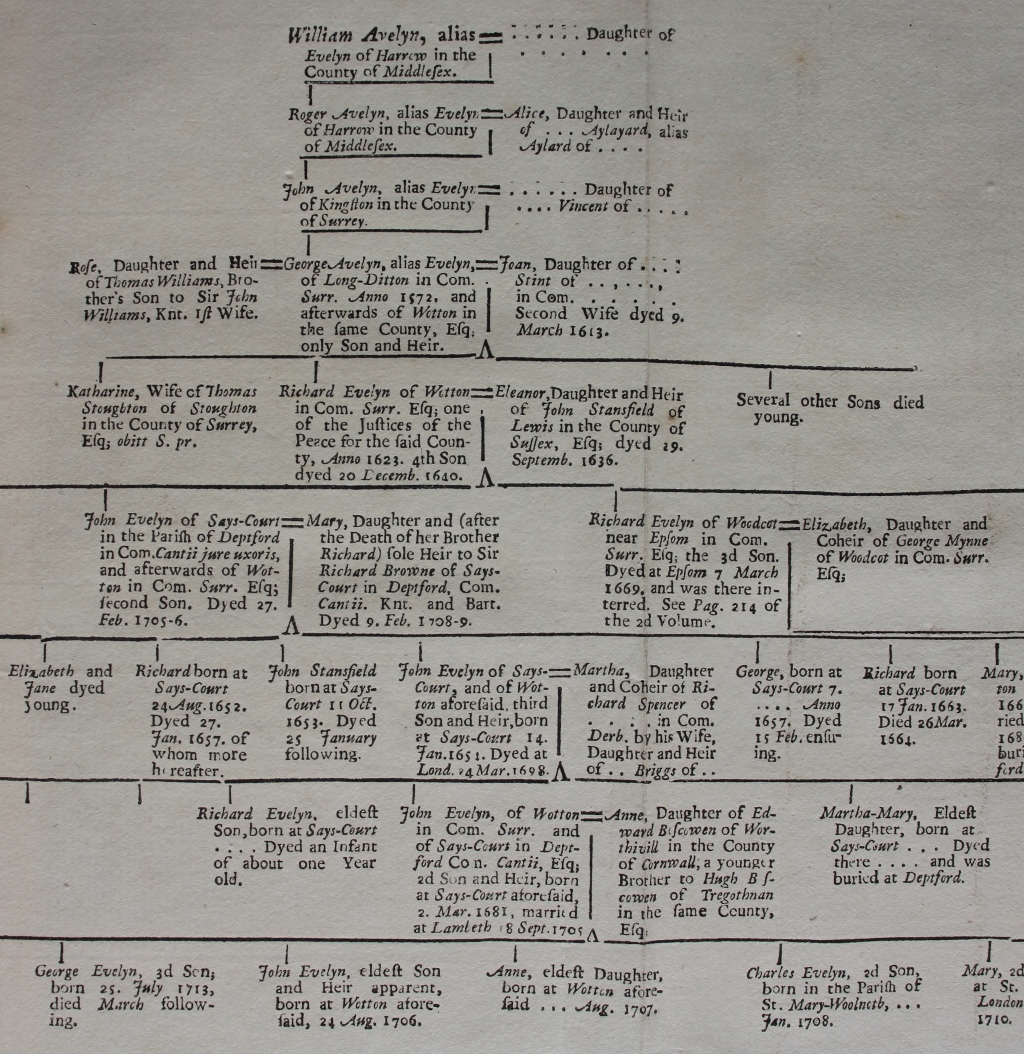
John Aubrey, The natural history and antiquities of the County of Surrey… 5 vols (London, 1718), iv, foldout of Evelyn pedigree (detail).
Equally significant is Aubrey’s concern with genealogy and local families. Like many contemporary antiquaries, he recognized that the histories of counties were inseparable from the histories of the landed families who occupied and administered them. Consequently, the work contains extensive accounts of prominent lineages, manorial succession, coats of arms, and patterns of inheritance. Some of the more eye-catching records include family trees spanning several pages, including the aforementioned foldout of the Evelyn family tree. These familial investigations are not presented solely as exercises in aristocratic commemoration but as mechanisms for tracing patterns of settlement, property ownership, political influence, and social change within the county. By linking families to specific estates, churches, and monuments, Aubrey creates a historical geography in which social relationships are embedded within the physical landscape itself.
Alongside its treatment of elite society, the work demonstrates an unusually broad interest in the customs and everyday practices of local communities. Aubrey records dialect vocabulary, seasonal festivals, popular beliefs, superstitions, agricultural traditions, medicinal practices, and oral legends, preserving aspects of local culture that were rarely considered worthy of scholarly attention by earlier historians. His inclusion of such material reflects a conviction that customs and traditions constituted valuable historical evidence, capable of illuminating the habits, beliefs, and identities of communities across generations. In this respect, Aubrey’s work anticipates later developments in folklore studies and ethnography by recognizing the historical significance of vernacular culture alongside more conventional documentary sources.
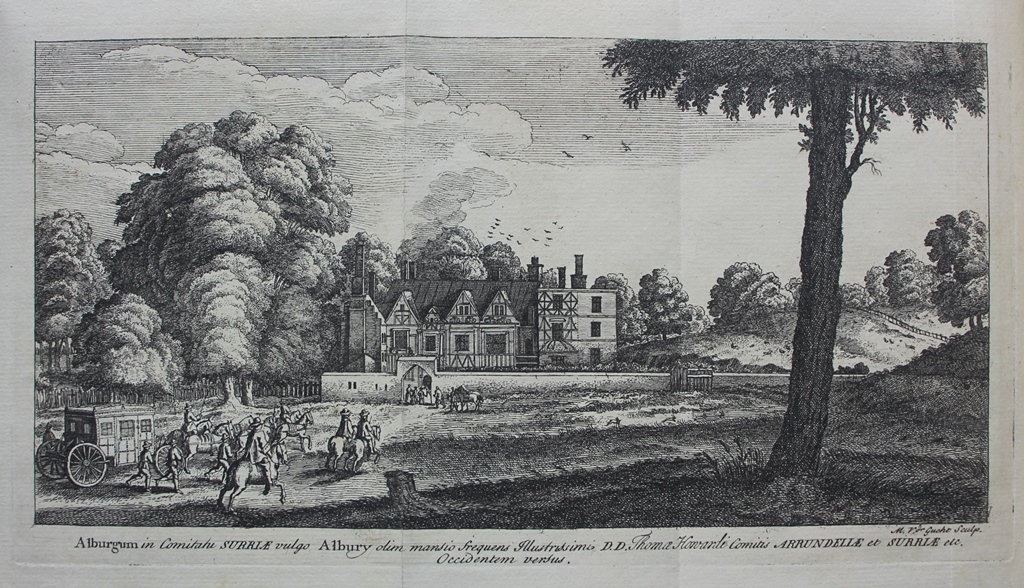
John Aubrey, The natural history and antiquities of the County of Surrey… 5 vols (London, 1718), iv, foldout of view of Albury park.
The natural historical dimension of the work is similarly substantial, but seems to have been edited down greatly. The one section that does not seem to have been pared down is Aubrey’s remarks on the soil content of Surrey. He describes content, moisture, etc., and professed wishes to create a geographical soil map of the area to aid in agricultural and architectural pursuits.[11] Aubrey catalogues rivers, springs, minerals, vegetation, and animal life a great deal (as instructed by Bacon) in the same context as the architectural and social-political content. His observations often extend beyond simple description to consider the relationship between the county’s natural resources and its patterns of settlement, agriculture, and economic activity. This attention to environmental conditions demonstrates the influence of contemporary natural philosophy, which encouraged scholars to examine the physical characteristics of particular localities as an essential component of historical understanding. Rather than treating natural history as separate from antiquarian enquiry, Aubrey presents the natural environment as an active force shaping the historical development of Surrey. This integration of natural and human history reflects the early modern conception that the physical environment and the societies inhabiting it could not be understood in isolation from one another.
Methodologically, The Natural History and Antiquities of the County of Surrey reflects Aubrey’s commitment to the collection and preservation of evidence from a wide variety of sources. His account draws upon personal observation, correspondence with local informants, parish registers, legal documents, family papers, inscriptions, oral testimony, and earlier chronicles. He frequently distinguishes between information obtained through direct inspection and material derived from the testimony of others, demonstrating an awareness of differing levels of evidential authority. This practice reflects his preference for assembling historical knowledge through the accumulation of multiple forms of evidence rather than relying exclusively upon established literary authorities. The structure of the work likewise reveals Aubrey’s priorities as an antiquary. Rather than constructing a continuous chronological narrative, he organizes his material around places, monuments, families, and observations, allowing individual pieces of evidence to accumulate into a broader portrait of the county. The resulting text retains the appearance of a working archive, incorporating supplementary notes, digressions, and additions that reflect the ongoing nature of his research. While this organization lacks the formal coherence expected of later county histories and even his own contemporaries, it illustrates Aubrey’s understanding of historical enquiry as a cumulative process of documentation rather than the production of a definitive narrative.
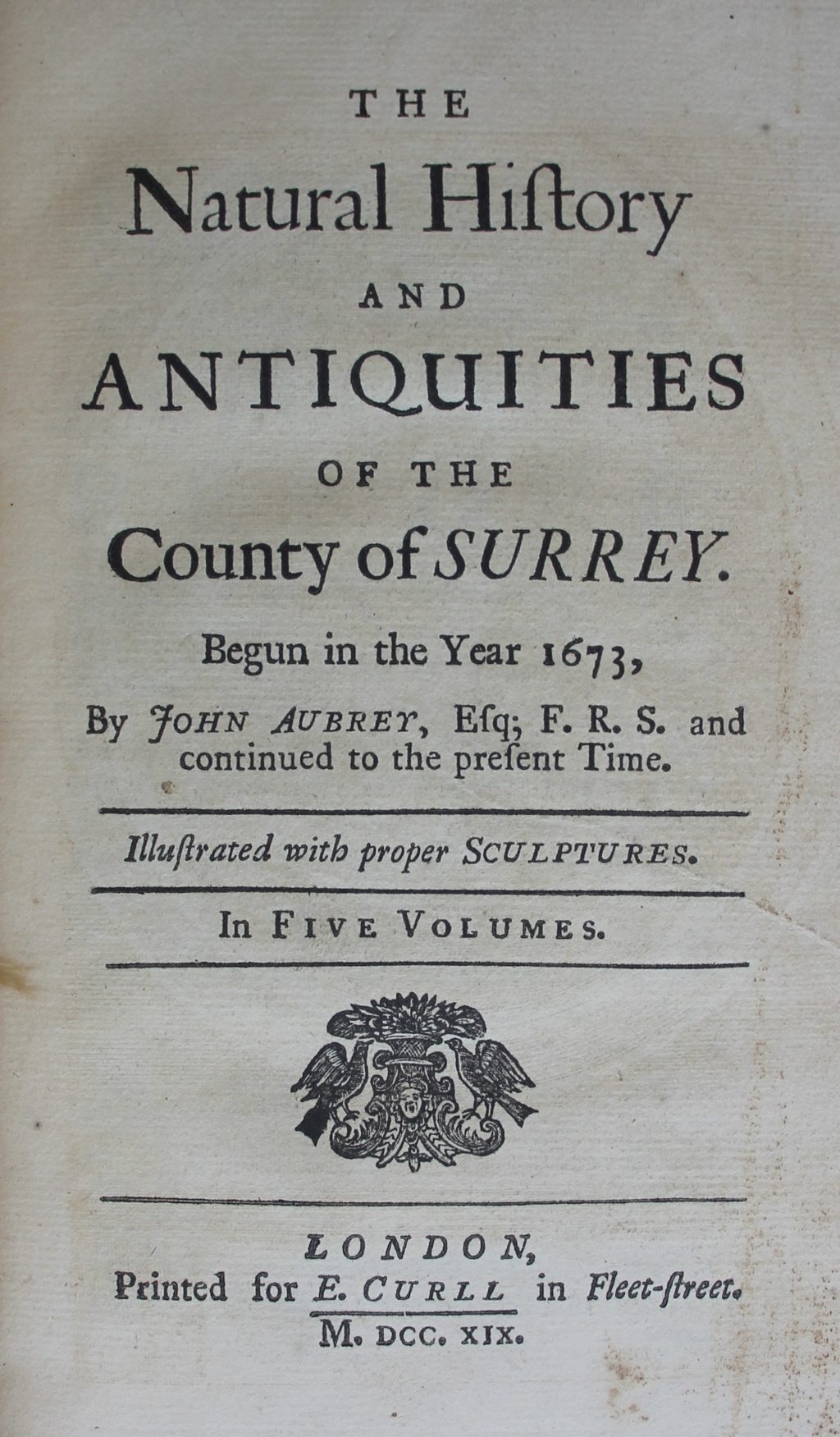
John Aubrey, The natural history and antiquities of the County of Surrey… 5 vols (London, 1718), i, title page.
All of this comes from the 1718 published version, which was ‘adopted’ by Richard Rawlinson (1690–1755) after Aubrey’s death and heavily edited before publication. Rawlinson specialized in cases like this, where a work had no chance of being published in its current state. He was of a similar mindset to Aubrey that all manuscripts had some inherent value and should be preserved, and took it so seriously that his motto was ‘I collect and I preserve.’[12] Rawlinson’s involvement extended beyond preparing the manuscript for publication. A distinguished antiquary in his own right, he approached Aubrey’s papers as an editor concerned with producing a coherent county history for an eighteenth-century readership. In preparing the text, Rawlinson compared Aubrey’s autograph manuscript with at least one additional copy, rearranged material, regularized its organization, and oversaw its publication under the title The Natural History and Antiquities of the County of Surrey. The Bodleian catalogue explicitly records that the printed edition was produced through comparison with another manuscript and that Aubrey’s text was ‘much revised’ before publication, indicating that the surviving printed work should not be regarded as an unmediated transcription of Aubrey’s original manuscript.
The extent of Rawlinson’s editorial intervention has remained a subject of scholarly discussion. While the fundamental structure, methodology, and overwhelming majority of the text derive from Aubrey’s seventeenth-century investigations, there is evidence that Rawlinson supplemented certain sections where Aubrey’s manuscript was incomplete. Local studies comparing the Bodleian manuscript with the printed edition suggest that descriptions of places absent from Aubrey’s surviving papers were supplied by Rawlinson, who is known to have undertaken his own tour of Surrey in 1717 while preparing the work for publication.[13] These additions appear to have been intended not to replace Aubrey’s work but to complete a project that had remained unfinished for over twenty years. Rawlinson also shaped the presentation of the work through editorial organization. Aubrey’s manuscript, A Perambulation of Surrey, retains the characteristic features of his working papers: digressions, marginal additions, and an associative rather than systematic arrangement of material.[14] The printed edition has much more structural coherence, incorporates engraved illustrations, and includes Rawlinson’s own biographical account of Aubrey in the opening volume, but cuts out all of Aubrey’s drawings of coats of arms and landscapes, as well as some of his more derailed tangents. As a result, the published Natural History and Antiquities of the County of Surrey occupies an intermediate position between seventeenth-century manuscript culture and eighteenth-century antiquarian publication.
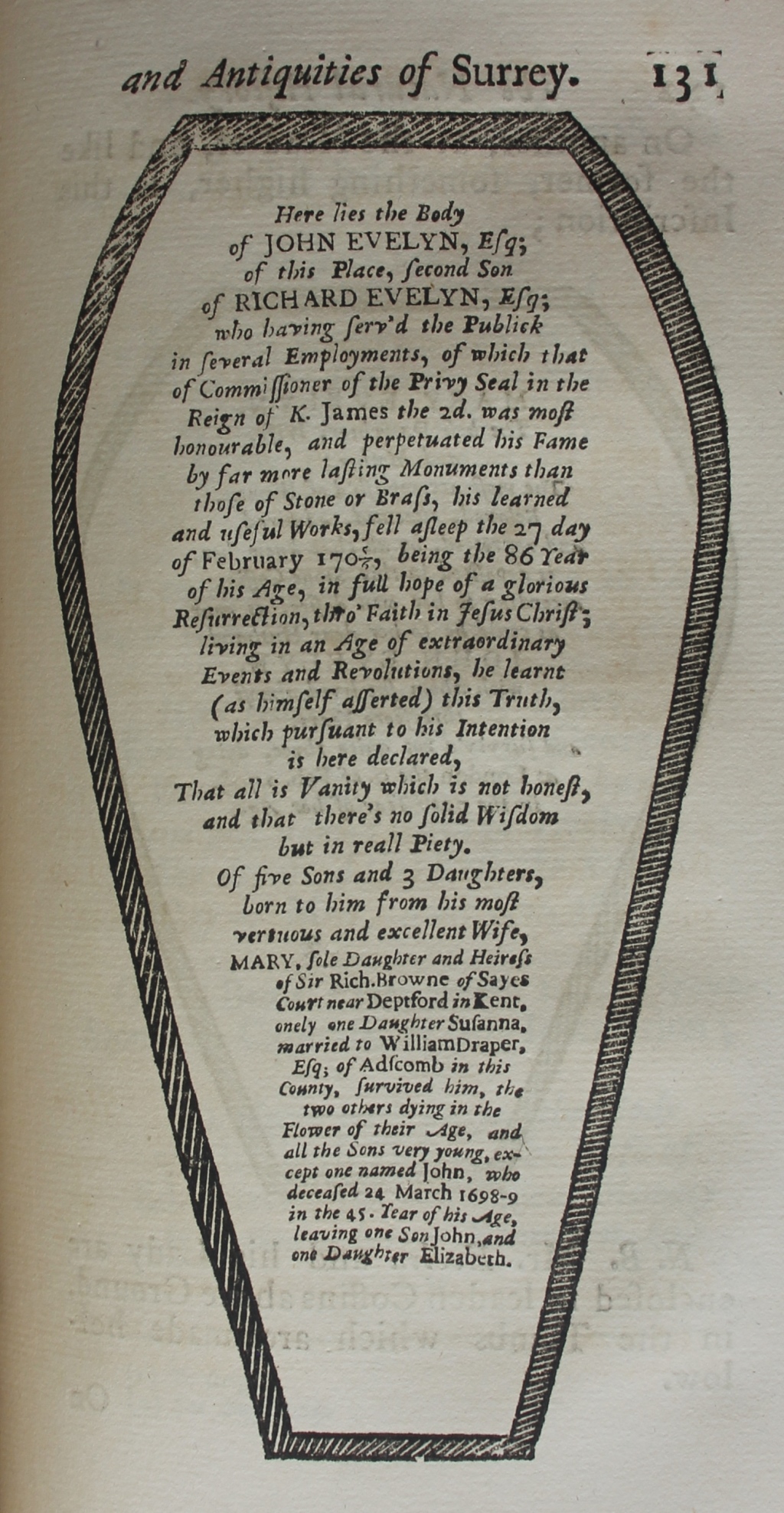
John Aubrey, The natural history and antiquities of the County of Surrey… 5 vols (London, 1718), iv, p. 131. The grave of John Evelyn.
The manuscript preserves Aubrey’s unfinished chorographical survey in its original working form, whereas the printed text represents an edited and revised version prepared for publication. Any analysis of The Natural History and Antiquities of the County of Surrey must therefore recognize that the printed edition reflects both Aubrey’s antiquarian methodology and Rawlinson’s editorial intervention, making it a collaborative textual artefact rather than a wholly authorial publication. The issue arises when Rawlinson significantly downplays his role in the work. His name is nowhere in the title page, nor is there mention anywhere of the significant edits that he assumed responsibility for. Only in comparing the handwritten Aubrey manuscript and the published Rawlinson version do the glaring differences appear. This means that the sections that Rawlinson significantly changed (of which there are plenty) or completely wrote himself are still in Aubrey’s name, which is dishonest at best. One of these major changes is the inclusion of John Evelyn’s grave, who died nine years after Aubrey. Two full pages are dedicated to depictions of the graves of Evelyn and his wife without a single mention that both of them outlived the supposed author by years.
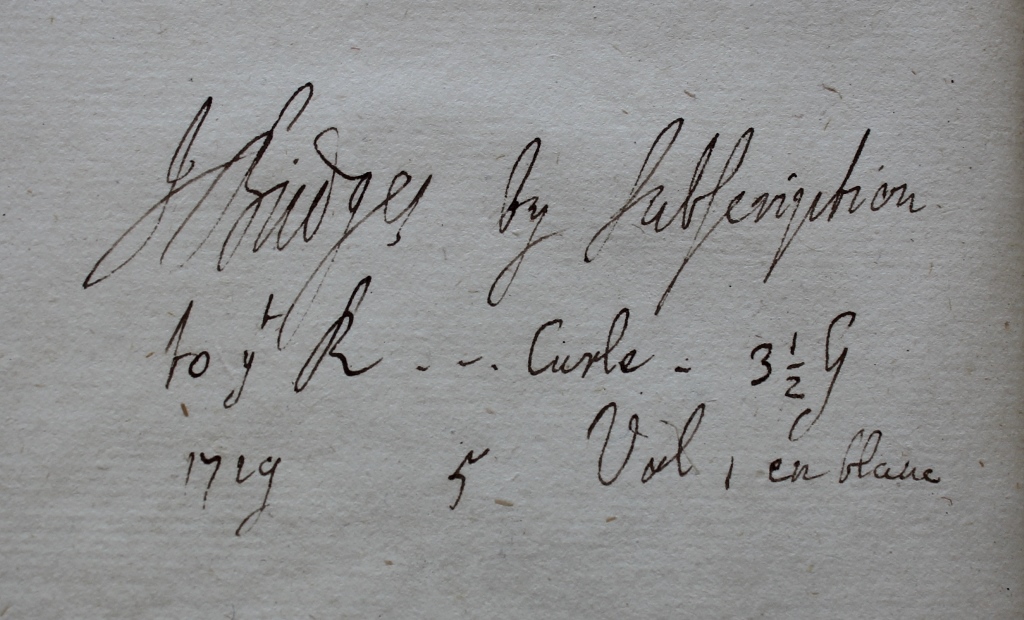
John Aubrey, The natural history and antiquities of the County of Surrey… 5 vols (London, 1718), i, flyleaf. J. Bridges inscription.
Edward Worth (1676–1733), bought The Natural History and Antiquities of the County of Surrey in 1726 from the London book auction of the library of John Bridges (bap. 1666, d. 1724). Numerous pieces of evidence point to this: the first being the inscription of the previous owner on the flyleaf of the first volume: ‘J. Bridges by Subscription…’. Secondly, we know that Worth owned a partial copy of the auction catalogue, where Aubrey’s work is marked.[15] In addition to this, he also owned a more extensive 1725 catalogue of Bridges’ collection : Catalogus librorum Johannis Bridges, armigeri; nuper ex Hospitio Lincolniensi (London, 1725), which was likewise sold by Jacob Tonson (1656?–1736) and John Watts (1700? –1763). As the auction catalogue makes clear, Worth purchased several other books from the Bridges auction, along with The Natural History and Antiquities of the County of Surrey. There are clear signs of the Aubrey volumes having been read since their publication, including slips of newspaper used as page markers in several places. Whether this was done by Worth or somebody else is unclear, but the newspaper does mention locations in Dublin, which points towards a reader more recent than Bridges. Oddly enough, it was through an innocuous scrap of paper that this was able to be figured out, which is a full circle moment for a man who never wanted his papers, and therefore his legacy and memory, to be discarded. These newspaper page markers demonstrate that Aubrey had not, in fact, been forgotten.
Text: Ms Emily Klos, Fourth Year Student, Philosophy and History, Colorado State University, Fort Collins, Colorado, USA.
Images: Mr. Antoine Mac Gaoithín, Library Assistant of the Edward Worth Library, Dublin.
Sources:
Aubrey, John, ‘A perambulation of Surrey anno domini 1673 (unfinished).’, Bodleian Library MS Aubrey 4.
Aubrey, John, The natural history and antiquities of the County of Surrey… 5 vols (London, 1718).
Balme, Maurice, Two Antiquaries: A Selection from the Correspondence of John Aubrey and Anthony Wood (Durham, 2001).
Bennett, Kate, ‘John Aubrey and the rhapsodic book’, Renaissance Studies, 28, no. 2 (April, 2014), 317–332.
Chambers, Douglas D. C., ‘Evelyn, John (1620–1706), diarist and writer’, Oxford Dictionary of National Biography.
Clapinson, Mary, ‘Rawlinson, Richard (1690–1755), topographer and bishop of the nonjuring Church of England’, Oxford Dictionary of National Biography.
Emery, F. V., ‘English Regional Studies from Aubrey to Defoe’, The Geographic Journal, 124, no. 3 (Sep, 1958), 315–325.
Enright, Brian, ‘Richard Rawlinson and the Publication of Aubrey’s ‘Natural History and Antiquities of Surrey’’, Surrey Archaeological Collections, 54, (1955), 124–133.
Fox, Adam, ‘Aubrey, John (1626–1697), antiquary and biographer’, Oxford Dictionary of National Biography.
Mendyk, Stan A. E., ‘This Secret Call’, in Stan A. E. Mendyk, ‘Speculum Britanniae’ : Regional Study, Antiquarianism, and Science in Britain to 1700 (Toronto, 1989), pp. 168–184.
Parry, Graham, ‘John Aubrey’, in Graham Parry, The Trophies of Time: English Antiquarians of The Seventeenth Century (Oxford, 1995), pp 275–307.
Yale, Elizabeth, ‘With Slips and Scraps: How Early Modern Naturalists Invented the Archive’, Book History, 12, (2009), 1–36.
[1] Fox, Adam, ‘Aubrey, John (1626–1697), antiquary and biographer’, Oxford Dictionary of National Biography.
[2] Ibid.
[3] Ibid.
[4] Yale, Elizabeth, ‘With Slips and Scraps: How Early Modern Naturalists Invented the Archive’, Book History, 12, (2009), 1–36.
[5] Ibid.
[6] Parry, Graham, ‘John Aubrey’, in Graham Parry, The Trophies of Time: English Antiquarians of The Seventeenth Century (Oxford, 1995), pp 275–307.
[7] Aubrey, John, The natural history and antiquities of the County of Surrey… 5 vols (London, 1718).
[8] Mendyk, Stan A. E., ‘This Secret Call’, in Stan A. E. Mendyk, ‘Speculum Britanniae’ : Regional Study, Antiquarianism, and Science in Britain to 1700 (Toronto, 1989), pp. 168–184.
[9] Balme, Maurice, Two Antiquaries: A Selection from the Correspondence of John Aubrey and Anthony Wood (Durham, 2001), p. 52.
[10] Chambers, Douglas D. C., ‘Evelyn, John (1620–1706), diarist and writer’, Oxford Dictionary of National Biography.
[11] Emery, F. V., ‘English Regional Studies from Aubrey to Defoe’, The Geographic Journal, 124, no. 3 (Sep, 1958), 315–325.
[12] Clapinson, Mary, ‘Rawlinson, Richard (1690–1755), topographer and bishop of the nonjuring Church of England’, Oxford Dictionary of National Biography.
[13] Enright, Brian, ‘Richard Rawlinson and the Publication of Aubrey’s ‘Natural History and Antiquities of Surrey’’, Surrey Archaeological Collections, 54, (1955), 124–133.
[14] Aubrey, John, ‘A perambulation of Surrey anno domini 1673 (unfinished).’, Bodleian Library MS Aubrey 4.
[15] Bibliothecae Bridgesianae catalogus, or, A catalogue of the entire library of John Bridges, late of Lincolns-Inn, Esq. ,,, (London, 1726), p. 192 (lot. No. 4171). I am grateful to Mr Antoine Mac Gaoithín for this reference.