Thomas Hobbes’ translation of The History of the Grecian War: In Eight Books. Written by Thucydides … (London, 1676).
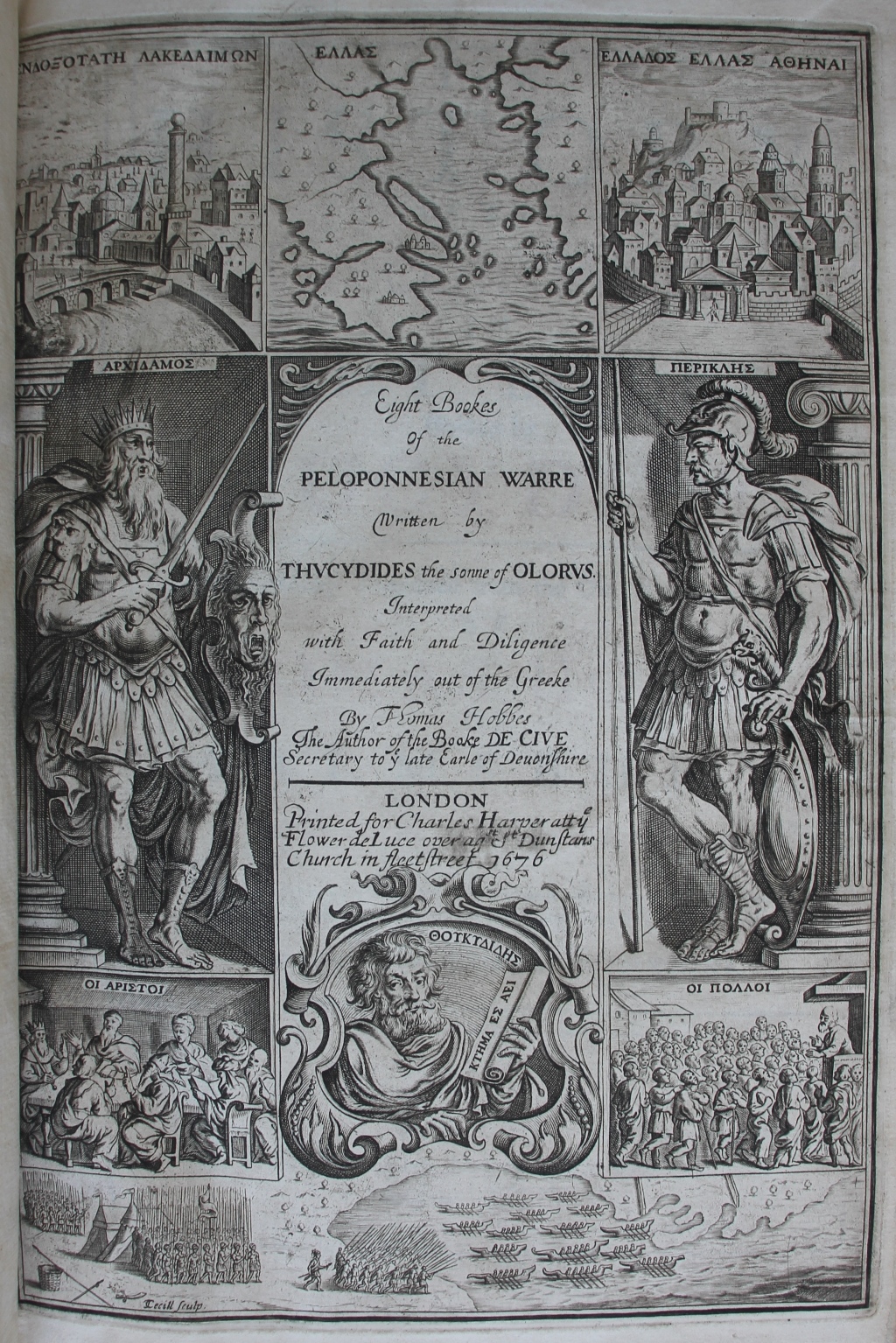
Thucydides, The history of the Grecian War: in eight books. Written by Thucydides. Faithfully translated from the original by Thomas Hobbes of Malmsbury … The second edition, much corrected and amended (London, 1676), engraved title page.
This month’s ‘Book of the Month’ is a translation of Thucydides’ History of the Peloponnesian War by Thomas Hobbes (1588–1679). It was originally published in 1629 and was later reissued twice. Hobbes then prepared a second edition in 1676, not long before his death.[1] It is this second edition that is in the possession of the Edward Worth Library. The above image showcases the engraved title page of this copy which depicts beautiful imagery featuring notable figures such as Thucydides himself, Pericles of Athens, and Archidamus of Sparta. The image and an accompanying plain title page provide concrete information about the author and the edition: that it was translated into English directly from the Greek; that Thomas Hobbes was also the author of De Cive; and that he had previously served as the secretary to the late Earl of Devonshire. The two title pages also give us important information about who printed and sold the work: Andrew Clarke, a printer active between 1670 and 1678 in Aldersgate Street, London, printed it for Charles Harper, a book seller in London, who was active between 1670 and 1709 at his shop the Flower de Luce, Fleet Street.[2] During this time Harper primarily published divinity, so his edition of Thucydides might be seen to be an outlier.[3]
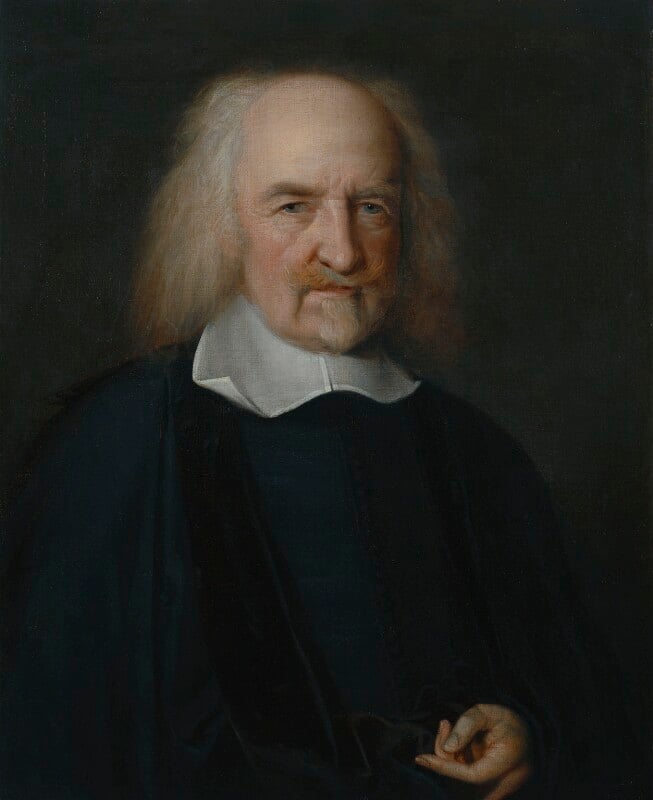
Portrait of Thomas Hobbes by John Michael Wright. Oil on canvas, circa 1669-1670. NPG 225. © National Portrait Gallery, London.
Thomas Hobbes was born in 1588 in Westport in the town of Malmesbury, Wiltshire. While his extended family were prosperous, Hobbes’ father was not affluent. However, familial support allowed Hobbes to receive an early education which provided him with an excellent foundation in Latin and Greek and by the time he was fourteen years old, he had entered Magdalen Hall, Oxford. Though he later castigated his education as being too centred around the ‘barbarisms of scholastic Aristotelianism’, as Malcolm suggests, Hobbes would also have engaged in fundamentally humanist studies, which would have involved wide reading of classical authors on rhetoric, moral philosophy, and history.[4] After he graduated, Hobbes was recommended for the position of tutor to William Cavendish (1590–1628), the son of William Cavendish (1551–1626), first earl of Devonshire. Malcolm suggests that Hobbes and William Cavendish were more like intellectual companions / friends rather than tutor and student.[5] Hobbes noted the time he spent with Cavendish as ‘by far the sweetest period of my life’.[6] This position provided Hobbes not only with intellectual freedom, as he was provided with whatever books he needed for his studies, but also contact with the Anglo-Scottish courtier society of Jacobean London. Consequently, as part of Cavendish’s entourage, Hobbes encountered many ideas and influential thinkers, particularly on their European tour: for example, Paolo Sarpi (1552–1623) and Fulgenzio Micanzio (1570–1654).
Hobbes’ translation of Thucydides marked the beginning of his career as a published author. His first printed work, it was finally published when he was in his forties. This achievement established Hobbes as one of the leading Grecianists of his day. For unknown reasons, once the work was completed, it took Hobbes a significant period to publish it, the catalyst finally being the sudden death of William Cavendish in the summer of 1628.[7] The ‘dedication to Cavendish’ coupled with Hobbes’ letter ‘to the readers’ explain his project. Within the former, Hobbes constructed a eulogy of Sir William Cavendish (1590–1628), second earl of Devonshire, which he addressed to his son (of the same name), advising him to read Thucydides: ‘I chuse rather to recommend him for his Writings, as having in them profitable instructions for Noble men, and such as may come to have the managing of great and weighty actions’.[8] This sentiment mirrors what Thucydides himself saw as the main justification for his work: ‘it will be enough for me, however, if these words of mine are judged useful by those who want to understand clearly the events which happened in the past and which (human nature being what it is) will, in some time or other and in much the same ways, be repeated in the future. My work is not a piece of writing designed to meet the taste of an immediate public but was done to last forever’.[9]
Hobbes, in his verse autobiography, explained that Thucydides was his favourite ancient historian, as he was attracted by his dissection of political motivation and his ‘realist’ approach to power along with his analysis of the role of rhetoric in political debate.[10] He placed him alongside other great authors such as Homer, Demosthenes, and Aristotle, and considered him the most ‘Politick Historiographer to have ever writ’.[11] Clearly then, Hobbes was a follower of the Renaissance tradition of turning to the Greek and Roman histories with the expectation of learning how to solve the problems of modern politics.[12] This is a clear reason for undertaking his translation. Moreover, Hobbes was also attracted to the project as a textual challenge as he noted the problems that had arisen from previous translations. He critiqued Italian and French translations, which had followed the Latin version of Lorenzo Valla (1407–57) that had been full of mistakes. It was from the already corrupted French translation that Thucydides had first been translated into English, leading Hobbes to conclude that Thucydides had been ‘traduced, rather then translated’.[13] This was what led him to complete a translation taken directly from Greek.
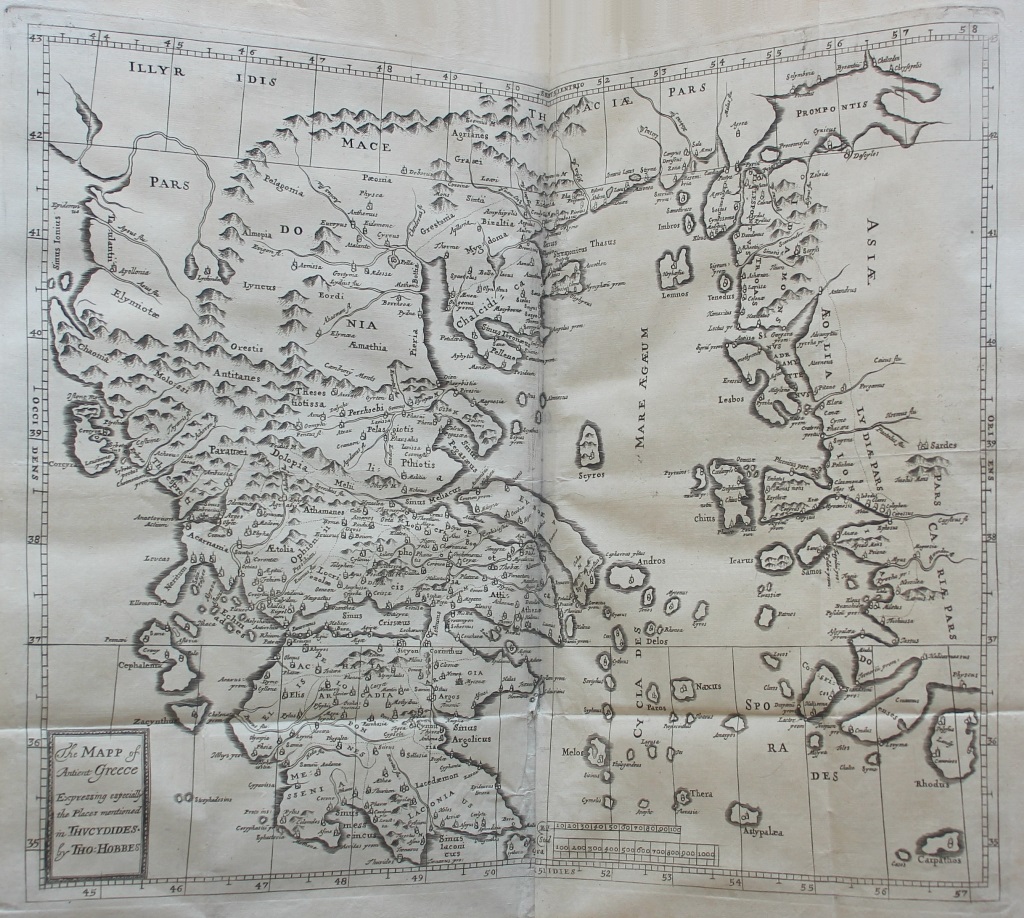
Thucydides, The history of the Grecian War: in eight books. Written by Thucydides. Faithfully translated from the original by Thomas Hobbes of Malmsbury … The second edition, much corrected and amended (London, 1676), foldout plate between Sigs. (e)2 and B1: map of ancient Greece.
Hobbes was not only concerned with the translation – he also took a keen interest in the accompanying illustrations for he felt that it was necessary for those who would be engaging with the English translation to be provided with maps as he recognised that many would not be familiar with Greece and its place names. He therefore included a map of Greece, one of Sicily, and two significant theatres of the war – Platea and Syracuse. The above map of Greece he himself drew, but the map of Sicily was taken from the work of the German geographer and historian, Philip Cluverius (1580–1622).[14] Additionally, as Malcolm points out, Hobbes also had or at least developed a practical knowledge of geometry by assisting the surveyor William Senior in his mapping of the Cavendish estates upon first being employed by the family.[15] This of course would have contributed to his cartography skills.
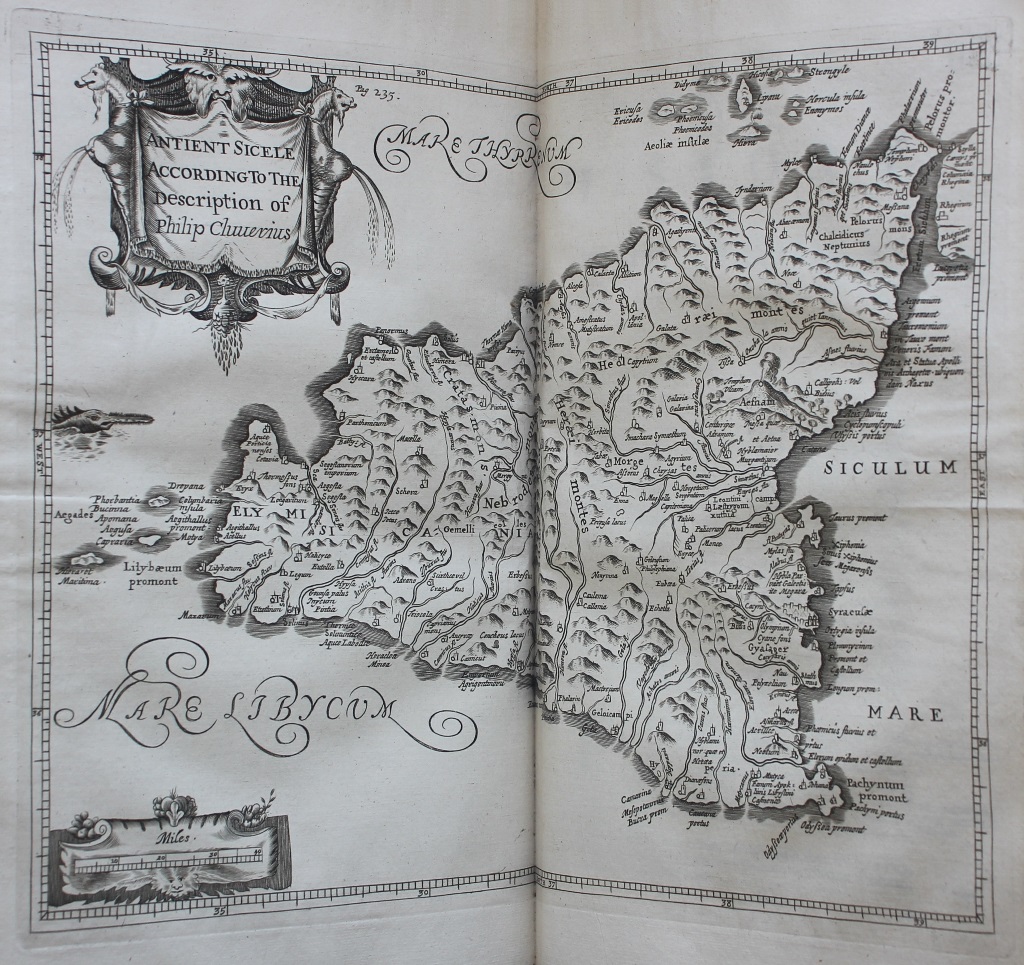
Thucydides, The history of the Grecian War: in eight books. Written by Thucydides. Faithfully translated from the original by Thomas Hobbes of Malmsbury … The second edition, much corrected and amended (London, 1676), double plate between Sigs. 2H1 and 2H2: map of ancient Sicily.
Both Hobbes and Thucydides wrote for instruction rather than the delight of the reader.[16] Certainly, Hobbes was not the first to believe that reading Thucydides would be useful for men in positions of power. The French translation from the Latin, completed by Claude de Seyssel (1450?–1520), Bishop of Marseilles, records that the translation had been done for Louis XII (1462–1515), King of France, who found in the text useful lessons for a modern monarch. Moreover, Thomas Nicolls (d. 1613), who translated the French version into English in 1550, belonged, at the time, to the school of translators presided over by the renowned humanist Sir John Cheke (1514–57). Nicolls dedicated his work to Cheke who at the time was tutor of Edward VI (1537–53), King of England. It is possible that Nicolls had in mind that Thucydides’ Histories would be of use to the young king.[17]
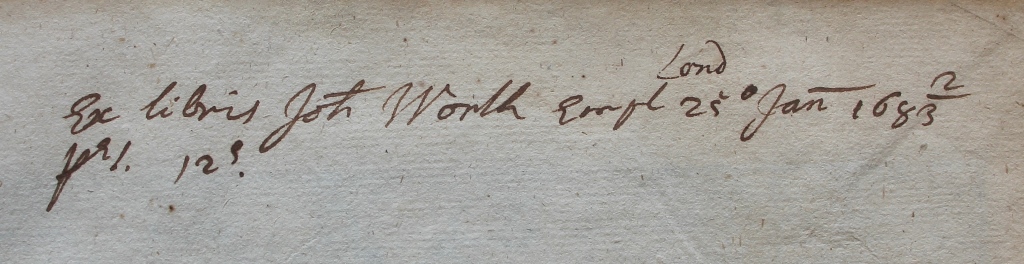
Thucydides, The history of the Grecian War: in eight books. Written by Thucydides. Faithfully translated from the original by Thomas Hobbes of Malmsbury … The second edition, much corrected and amended (London, 1676), flyleaf inscription.
Perhaps Edward Worth’s father, John Worth (1648–88), Church of Ireland Dean of St Patrick’s Cathedral, Dublin, was thinking along the same lines for his son, for it is interesting to note that it was John Worth, not Edward, who purchased the translation of Thucydides still within the Edward Worth Library today. We know this because John’s signature, along with the date of purchase, is located on the flyleaf (as can be seen in the above image). His signature may also be found on the plain title page of the work. John Worth clearly purchased the volume in January 1682/3, when his son Edward Worth (1676–1733) was only about six years old. This might appear unusual but, as we have already seen, Thucydides’ Histories was a text which might be recommended to quite young scholars. Thus, John Worth was following a common trend of educating one’s children by encouraging reading of the classical authors.
It is also of interest that Edward Worth decided to keep this copy as part of his collection, for he did not retain all his father’s books. The core of Edward’s collection had been inherited from his father John and his grandfather, Edward Worth (d. 1669, Church of Ireland Bishop of Kilalloe). In John’s will, he had left his library to whichever of his sons should later become a clergyman of the Church of Ireland but both Edward and his brother Michael ignored this wish and the collections of both John and Michael ended up as the property of Edward.[18] Some of John Worth’s books remained in the Worth Library, others he alienated to his cousin, Edward Worth of Rathfarnham (d. 1741).[19]

Thucydides, The history of the Grecian War: in eight books. Written by Thucydides. Faithfully translated from the original by Thomas Hobbes of Malmsbury … The second edition, much corrected and amended (London, 1676), title flap on Worth’s copy.
Edward Worth, a connoisseur collector known for his taste in fine bindings, was clearly not holding onto the copy for its binding, for the binding shares the simplicity of many of the books bound for his father: It is bound in late seventeenth-century English blind-tooled mottled brown calf. Calfskin, produced by tanning and dying skins of young cows was the leather most used in England for covering bindings between the fifteenth and nineteenth centuries. It was usually dyed some shade of brown.[20] The binding was not entirely plain, for the edges of the text-block sport a marbled design, a technique that had originally been perfected in the Middle East in the late medieval period. It became increasingly frequent in England after 1660 and from then onwards, until well into the nineteenth century, marbled end leaves are quite common in bindings of middling quality and upwards.[21] John’s copy also reminds us that books were not always shelved vertically: as the above image of a title-flap on the fore-edge demonstrates, this book would originally have been shelved horizontally. John Worth’s book was thus given a typical binding of the period; one intended to be durable and intended for use.
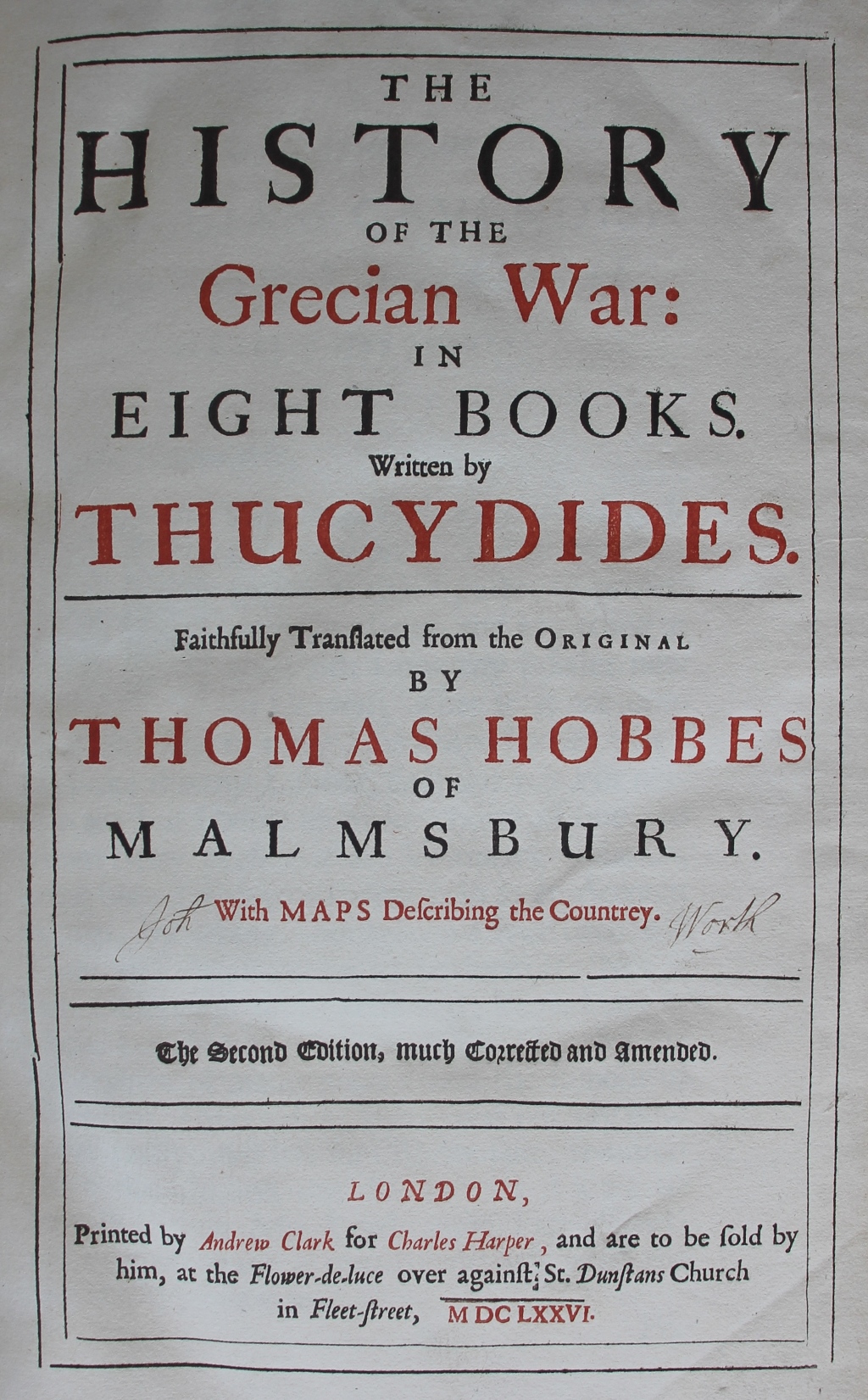
Thucydides, The history of the Grecian War: in eight books. Written by Thucydides. Faithfully translated from the original by Thomas Hobbes of Malmsbury … The second edition, much corrected and amended (London, 1676), title page.
Thucydides appears to have had a lasting impact on Hobbes in many ways. During the 1640s, the period that initiated the great civil wars in England which led to the execution of King Charles I (1600–49), Hobbes had left England as did many aristocratic families who were threatened by Cromwell’s republican armies.[22] It was during this time that Hobbes wrote his major treatise on psychology, politics, and religion entitled Leviathan. It was completed in 1651 and had been written in English and published in England which strongly suggests that it was intended as a contribution to contemporary political debate.[23] Hobbes himself returned to England upon its publication. As mentioned above, Hobbes opposed Aristotle’s teachings. He blamed the influence of Aristotle for much of the civil conflict of his age, specifically the Aristotelian preference for self-governance which Hobbes saw as one of the great root causes of civil war. Within Leviathan, he set out to undermine the authority of Aristotle in civil, political, and moral science.[24] This text was unpopular among his contemporaries, gaining him the nickname ‘the monster of Malmsbury’.[25]
It is within Leviathan, that multiple scholars see remnants of Thucydides.[26] Gabriella Slomp even suggests that Hobbes’ later political theory develops some of Thucydides’ insights; specifically on the function of fear and the effect of ambition on political associations.[27] For example, in book one of Thucydides, during the Athenian’s speech at the debate at Sparta, the Athenians state that they had done nothing contrary to human nature in accepting an empire when it was offered to them and then refusing to give it up. They argue that three very powerful motives prevent them from doing so – security, honour, and self-interest.[28] This is in relation to the Peloponnesian allies discussing how the Athenians as leaders of what modern readers would call the Delian League, had repeatedly turned allies into subjects, formulating an Athenian empire. Chapter thirteen of Leviathan details Hobbes’ version of the three principal causes of dispute – gain, safety, and reputation.[29] This is just one of numerous examples of Thucydides permeating the political theory of Hobbes. Hobbes also puts stress on the concept of fear, a theme that resurfaces throughout Thucydides’ history. Thucydides himself states that in his own opinion, the true reason that the Peloponnesian war erupted was ‘the growth of Athenian power and the fear which this caused Sparta’.[30] Throughout the work of Thucydides, there lies the question of how fear is to be channelled to result in a stable social order. Hobbes’ Leviathan appears to be an attempt to answer that question.[31] Within the text, Hobbes notes that fear breeds war between nations but its absence breeds anarchy within nations. This harkens back to Thucydides’ iconic account of the outbreak of plague in Athens during the second year of the Peloponnesian war. He records that the plague did not discriminate and anyone fell victim to it. Therefore, people no longer feared divine or human punishment leading Athens to fall into a state of lawlessness.[32]
Unlike modern scholars of Thucydides who try to avoid projecting concrete beliefs onto Thucydides himself, Hobbes offered rather definite conclusions about him. In his translation of Thucydides, under the ‘life and history’ of the author, Hobbes concludes that Thucydides was a concealed royalist.[33] Robin Sowerby argues that while Hobbes’ experience of civil war in England would have contributed to his political philosophy, Thucydides’ summary of Athens’ downfall in book II of his history, and the weakness of their democracy may have also influenced Hobbes, pushing him towards royalist absolutism.[34] As it was typical of Renaissance minds to turn to the Greek and Roman histories with the intention of learning how to solve contemporary problems, the shortcomings of Athenian democracy were automatically taken to heart by Renaissance readers.[35]
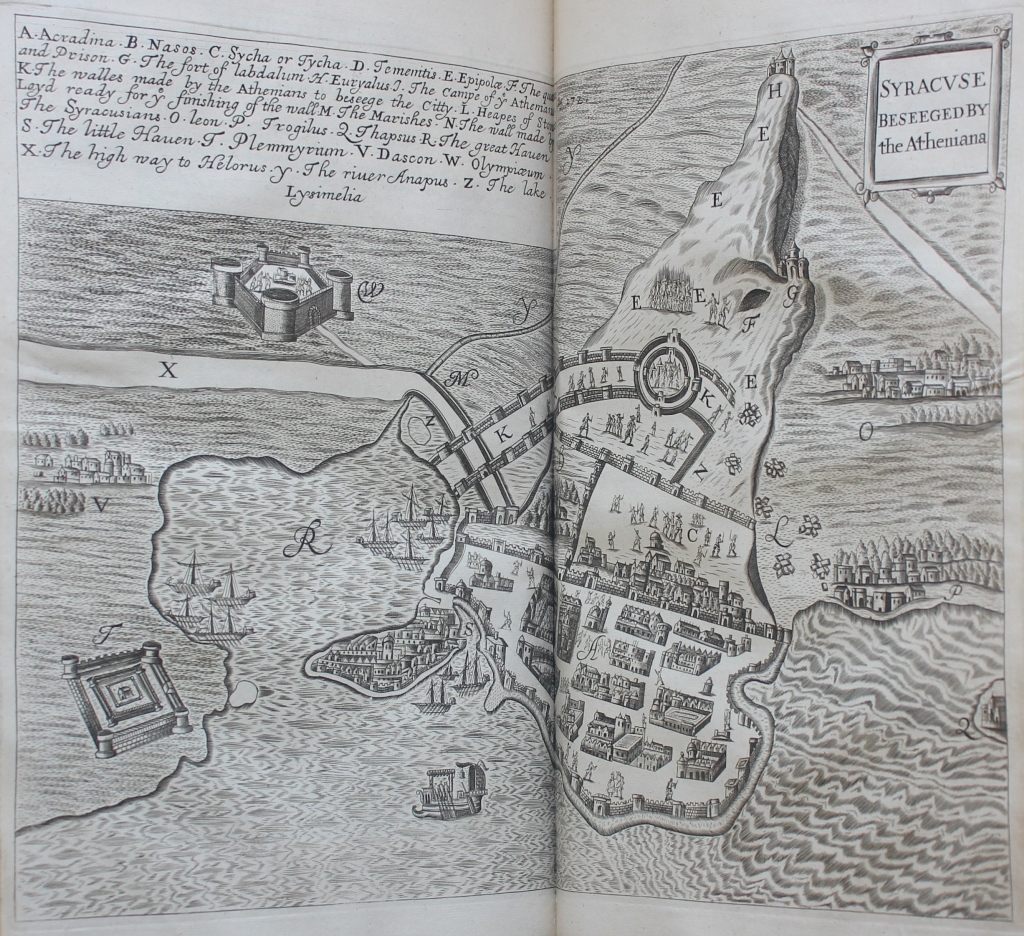
Thucydides, The history of the Grecian War: in eight books. Written by Thucydides. Faithfully translated from the original by Thomas Hobbes of Malmsbury … The second edition, much corrected and amended (London, 1676), plate between Sigs. 2M4 and 2N1: map of Syracuse.
It is interesting to note that Hobbes’ interest in Thucydides, as a source of profitable instruction for political leaders, is still reflected today. Thucydides’ history has become a key text for several academic disciplines: not only classical history, but political science and international relations too.[36] Many of the issues addressed by Thucydides more than 2,000 years ago still maintain their relevance today, such as: the reasons countries go to war; the ways democracies can fail to promote the common good both at home and abroad where they control an empire; and the relationship between morality, security, and good leadership in a democracy.[37]
A recent example of the enduring legacy of Thucydides in political debate came on 20 January 2026, when Mark Carney, the Prime Minister of Canada, gave a speech at the World Economic Forum, during which he invoked Thucydides’ famous quotation: ‘the strong can do what they can, and the weak must suffer what they must’.[38] This quote was taken from what is known as Thucydides’ ‘Melian Dialogue’ which occurs before the Athenians decided to bring their full military might against Melos – a small, defenceless, but independent island in the Aegean Sea – which the Athenians wanted to absorb into their empire. This, along with the earlier mentioned transformation of the Delian League into the Athenian empire cannot help but spark connections between contemporary global politics and the events of over 2,000 years ago. Classicists were keen to point to parallels: Brock University Professor of Classics and Archaeology Michael Carter commented that: ‘The Melian arguments are based on justice, morality, hope, and a sense of right and wrong, whereas Athenian responses essentially point out how they think the world really works: big fish eat little fish, and that’s just the way it is’.[39] He goes on to say: ‘It is hard not to think of smaller countries and territories, like Ukraine or Greenland or Taiwan, caught up in the ambitions of the great powers, the hegemons of today’.[40]
Prime Minister Carney was presumably aware that Thucydides himself did not necessarily endorse the phrase he invoked. Either way Mark Carney’s use of it clearly highlights the lessons that the history of the Delian League offers present day readers: that the maintenance of a balanced distribution of powers is of the upmost importance.[41] Thucydides’ History of the Peloponnesian War is, thus, a formidable text that retains its significance for modern readers, still warranting commentary, re-evaluation and reinterpretation. Thomas Hobbes clearly played a vital role in communicating Thucydides’ Histories and ensuring that his work would receive its due recognition as one of the foundations of modern political theory.
Text: Ms Kayleigh O’ Connor, fourth-year student Ancient and Medieval History and Culture BA degree, Trinity College Dublin.
Bibliography:
Boran, Elizabethanne, ‘Dr. Edward Worth: A Connoisseur Book Collector in Early Eighteenth-Century Dublin’, in Boran, Elizabethanne (ed.), Book Collecting in Ireland and Britain 1650-1850 (Dublin, 2018), pp 80–103.
D’Angour, Armand, ‘From Pericles to Davos’, Engelsberg Ideas.
Fisher, Mark, A MACAT Analysis: Thucydides’s The History of the Peloponnesian War (London, 2017).
Gale, Alexander, ‘Was the Delian League the NATO of the Ancient Greek World?’, Greek Reporter.
Hobbes, Thomas, The Life of Mr. Thomas Hobbes of Malmsbury (London, 1680).
Klosko, George, and Daryl Rice, ‘Thucydides and Hobbes’s State Of Nature’, History of Political Thought, 6, no. 3 (1985), 405–9.
Lee, Sidney, and Victor Stater, ‘Cavendish, William, Second Earl of Devonshire (1590-1628), Nobleman’, Oxford Dictionary of National Biography.
Malcolm, Noel, ‘Hobbes, Thomas (1588-1679), Philosopher’, Oxford Dictionary of National Biography.
Minaker, Gillian, ‘Why ancient lessons cited by Carney remain relevant to today’s shifting world order’, The Brock News.
Pearson, David, English Bookbinding Styles 1450-1800 (London and New Castle, Del., 2005).
Plomer, Henry R., et al., A Dictionary of the Printers and Booksellers Who Were at Work in Egland, Scotland and Ireland from 1668 to 1725 (London, 1968).
Schlatter, Richard, ‘Thomas Hobbes and Thucydides’, Journal of the History of Ideas, 6, no. 3 (1945), 350–62.
Slomp, Gabriella, ‘Hobbes, Thucydides, and the Three Greatest Things’, History of Political Thought, 11, no. 4 (1990), 565–86.
Smith, Steven B, ‘12. The Sovereign State: Hobbes’ Leviathan’, Yale Courses [YouTube].
Sowerby, Robin, ‘Thomas Hobbes’s Translation of Thucydides’, Translation and Literature, 7, no. 2 (1998), 147–69.
Thucydides, and Thomas Hobbes (tr.), The History of the Grecian War: In Eight Books. Written by Thucydides (London, 1676).
Thucydides, History of the Peloponnesian War, Translated by Rex Warner with an introduction and notes by M. I. Finlay (London, 1972).
[1] Sowerby, Robin, ‘Thomas Hobbes’s Translation of Thucydides’, Translation and Literature, 7, no. 2 (1998), 147.
[2] Plomer, Henry R., et al., A Dictionary of the Printers and Booksellers Who Were at Work in England, Scotland and Ireland from 1668 to 1725 (London, 1968), pp 79–80, 144.
[3] Ibid., p. 144.
[4] Malcolm, Noel, ‘Hobbes, Thomas (1588-1679), Philosopher’, Oxford Dictionary of National Biography.
[5] Ibid.
[6] Hobbes, Thomas, The Life of Mr. Thomas Hobbes of Malmsbury (London, 1680). p. 4; Lee, Sidney, and Victor Stater, ‘Cavendish, William, Second Earl of Devonshire (1590-1628), Nobleman’, Oxford Dictionary of National Biography.
[7]Malcolm, ‘Hobbes, Thomas’, ODNB.
[8] Thucydides, and Thomas Hobbes (tr.), The History of the Grecian War: In Eight Books. Written by Thucydides (London, 1676), Sig. A2r.
[9] Thucydides, History of the Peloponnesian War, Translated by Rex Warner with an introduction and notes by M. I. Finlay (London, 1972), p. 48.
[10] Hobbes, ‘The Life of Mr. Thomas Hobbes’, pp 4–5.
[11] Thucydides, ‘The History of the Grecian War’, Sig. A3v.
[12] Schlatter, Richard, ‘Thomas Hobbes and Thucydides’, Journal of the History of Ideas, 6, no. 3 (1945), 350.
[13] Thucydides, ‘The History of the Grecian War’, Sig. A3v.
[14] Ibid., Sig. A4r.
[15] Malcolm, ‘Hobbes, Thomas’, ODNB.
[16] Sowerby, ‘Hobbes’s Translation’, 153.
[17] Schlatter, ‘Hobbes and Thucydides’, 350–352.
[18] Boran, Elizabethanne, ‘Dr. Edward Worth: A Connoisseur Book Collector in Early Eighteenth-Century Dublin’, in Boran, Elizabethanne (ed.), Book Collecting in Ireland and Britain 1650-1850 (Dublin, 2018), pp 80–88.
[19] On this see Boran, Elizabethanne, ‘The Library of John Worth, 1648-1688: Bookbinding and the Book Trade in late seventeenth-century Ireland’ (MLIS, University of Northumbria, Newcastle, 2009).
[20] Pearson, David, English Bookbinding Styles 1450-1800 (London and New Castle, Del., 2005), pp 17–18.
[21] Ibid., p. 39.
[22] Smith, Steven B, ‘12. The Sovereign State: Hobbes’ Leviathan’, Yale Courses [YouTube].
[23] Malcolm, ‘Hobbes, Thomas’, ODNB.
[24] Smith, ‘Hobbes’ Leviathan’, [Youtube].
[25] Millican, Peter, ‘2.2 Introduction to Thomas Hobbes’, University of Oxford [YouTube].
[26] Klosko, George, and Daryl Rice, ‘Thucydides and Hobbes’s State Of Nature’, History of Political Thought, 6, no. 3 (1985), 405.
[27] Slomp, Gabriella, ‘Hobbes, Thucydides, and the Three Greatest Things’, History of Political Thought, 11, no. 4 (1990), 565.
[28] Thucydides, History of the Peloponnesian War (1972), p. 80.
[29] Slomp, ‘Three Greatest Things’, 566.
[30] Thucydides, History of the Peloponnesian War (1972), p. 49.
[31] Slomp, ‘Three Greatest Things’, 572.
[32] Thucydides, History of the Peloponnesian War (1972), p. 155.
[33] Thucydides, ‘The History of the Grecian War’, Sig. (a2)r.
[34] Sowerby, ‘Hobbes’s Translation’, 155–156.
[35] Ibid., 157.
[36] Fisher, Mark, A MACAT Analysis: Thucydides’s The History of the Peloponnesian War (London, 2017), pp. 10–11.
[37] Ibid., p. 12.
[38] Thucydides, History of the Peloponnesian War (1972), p. 402.
[39] Minaker, Gillian, ‘Why ancient lessons cited by Carney remain relevant to today’s shifting world order’, The Brock News.
[40] Ibid.
[41] D’Angour, Armand, ‘From Pericles to Davos’, Engelsberg Ideas; Gale, Alexander, ‘Was the Delian League the NATO of the Ancient Greek World?’, Greek Reporter.