Making the News: The Spectator and The Guardian in the Early Eighteenth Century
Introduction
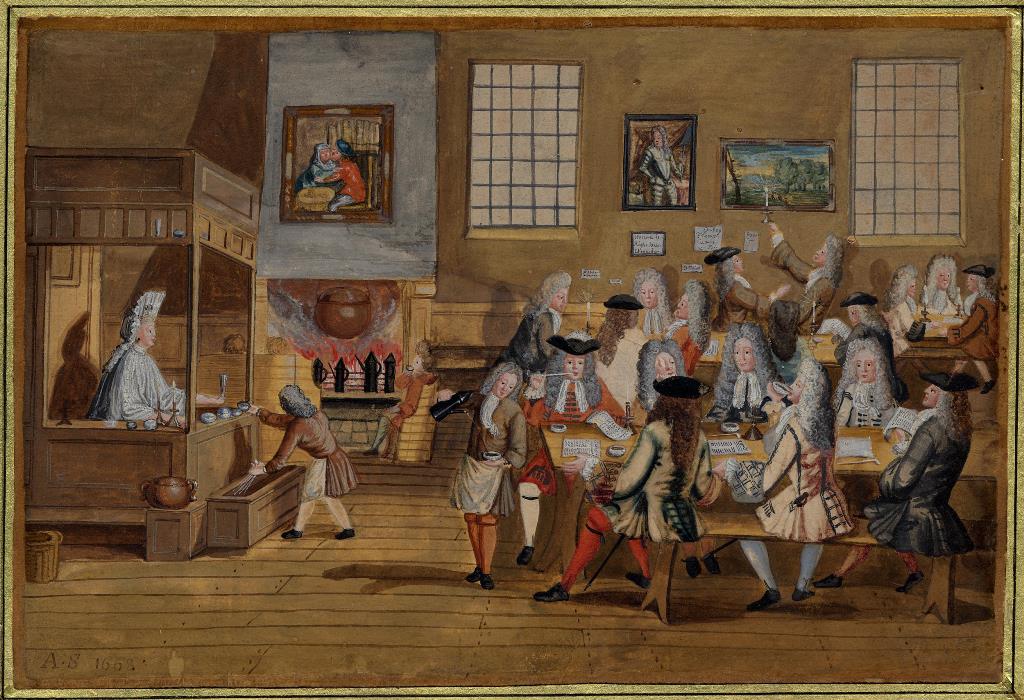 Interior of a London Coffee-house; maid in white lace frontage behind canopied bar and manservant taking clay pipes from a chest, at centre, another servant pouring coffee, to right, group of men seated on benches with newspapers and cups, in background, fire with cauldron, various paintings and notices on wall, by Anonymous. Drawing, c. 1690–1700. Museum number: 1931,0613.2. © The Trustees of the British Museum. Shared under a Creative Commons Attribution-NonCommercial-ShareAlike 4.0 International (CC BY-NC-SA 4.0) licence.
In eighteenth-century England, news production was rapidly changing form.[1] The genre was in flux, as political and economic shifts continuously altered both the demand for news and the material conditions to produce it.[2] But following the Reformation and the subsequent rise and fall of the Licensing Act, which censored unsanctioned news, the periodical rose to prominence.[3] This kind of informal essay, almost identical to hard news in form but more literary and introspective in content, transformed newswriting and the social sphere in which it was consumed.[4] Joseph Addison (1672–1719) and Richard Steele (bap. 1672, d. 1729), two of the most prolific periodical authors, embarked on numerous different publications together, namely The Spectator and The Guardian, of which several volumes are housed in the Edward Worth Library. Though not directly linked to the contemporary publications of the same name, the modern-day Spectator is no doubt recalling its eighteenth-century counterpart, and the persistence of both their titles speak — intentionally or not — to how transformative the original periodicals were to the media sphere.[5] The hundreds of combined issues collected by Worth can be examined from a journalistic, sociological, and/or historical perspective, illustrating the material reality of eighteenth-century news production, the emerging taste of the middle class, and the urban space in which it was canonised.
Joseph Addison & Richard Steele: early life
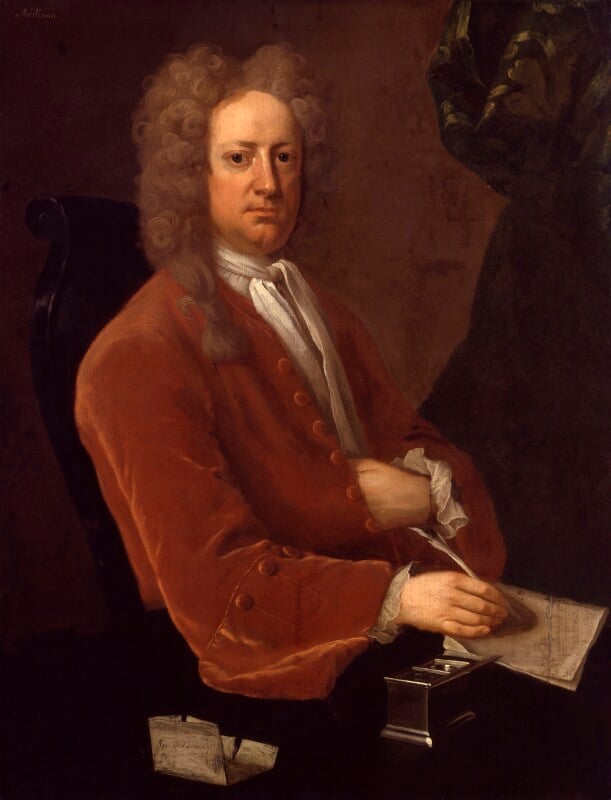
Joseph Addison, by Michael Dahl. Oil on canvas, 1719. NPG 714. © National Portrait Gallery, London.
Born in Milston, England in 1672, Joseph Addison spent much of his early life receiving a classical education at a number of schools. One of these was the Charterhouse School in London, where, at age thirteen, he met his future collaborator Richard Steele.[6] He attended the University of Oxford alongside Steele where he studied Latin poetry and built relationships with John Dryden (1631–1700) and Jacob Tonson, the elder (1655/6–1736), who went on to publish several of his theatrical and periodical works, including Cato, The Spectator and The Guardian.[7] Addison spent the end of the seventeenth century abroad, primarily in France, where he studied language and worked as a secretary at the Paris embassy. However, during his travels, the Whigs (Addison’s political party) were forced to cede power in England, putting Addison on unstable political ground when he returned to his home country in 1704.[8]
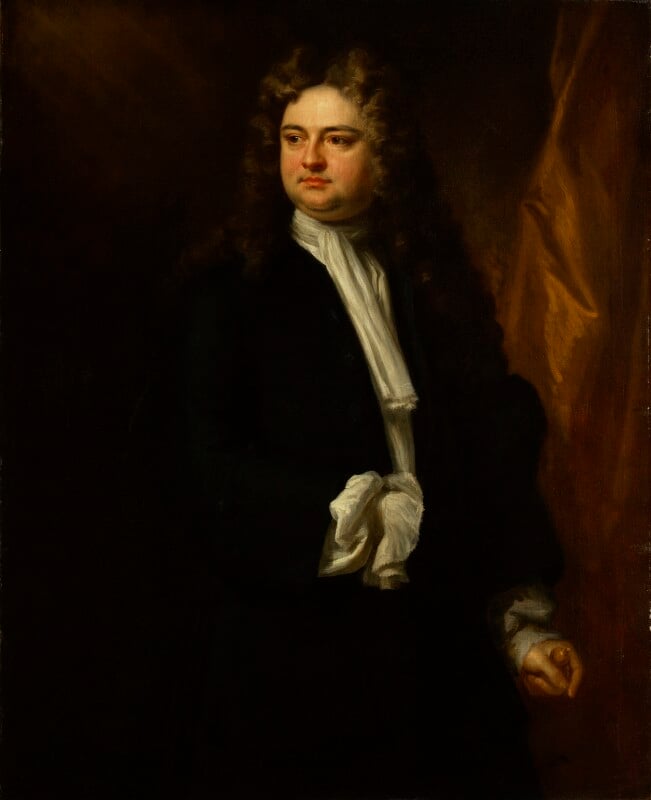
Sir Richard Steele, by Jonathan Richardson. Oil on canvas, 1712. NPG 5067. © National Portrait Gallery, London.
Sir Richard Steele, on the other hand, was born into a protestant family in Dublin, Ireland, in 1672.[9] His father being a wealthy explorer in Persia and India, Steele was raised by his extended aristocratic family and moved to London at age thirteen to attend the Charterhouse School with Addison. Like Addison, he subsequently enrolled in Oxford, but left before graduating to enlist in a combat unit between 1692–1694.[10] Following his military service, Steele almost killed an opponent in a duel in Hyde Park, worked as a secretary to John Cutts (1660/61–1707), Baron Cutts of Gowran, in London, and fathered an illegitimate child with Elizabeth Tonson (b. 1651), the sister of his future publisher.[11] He then returned to his military service, guarding a fort in Suffolk until 1705, when he left the army and began to focus solely on a literary and theatrical career.
Theatrical & political careers
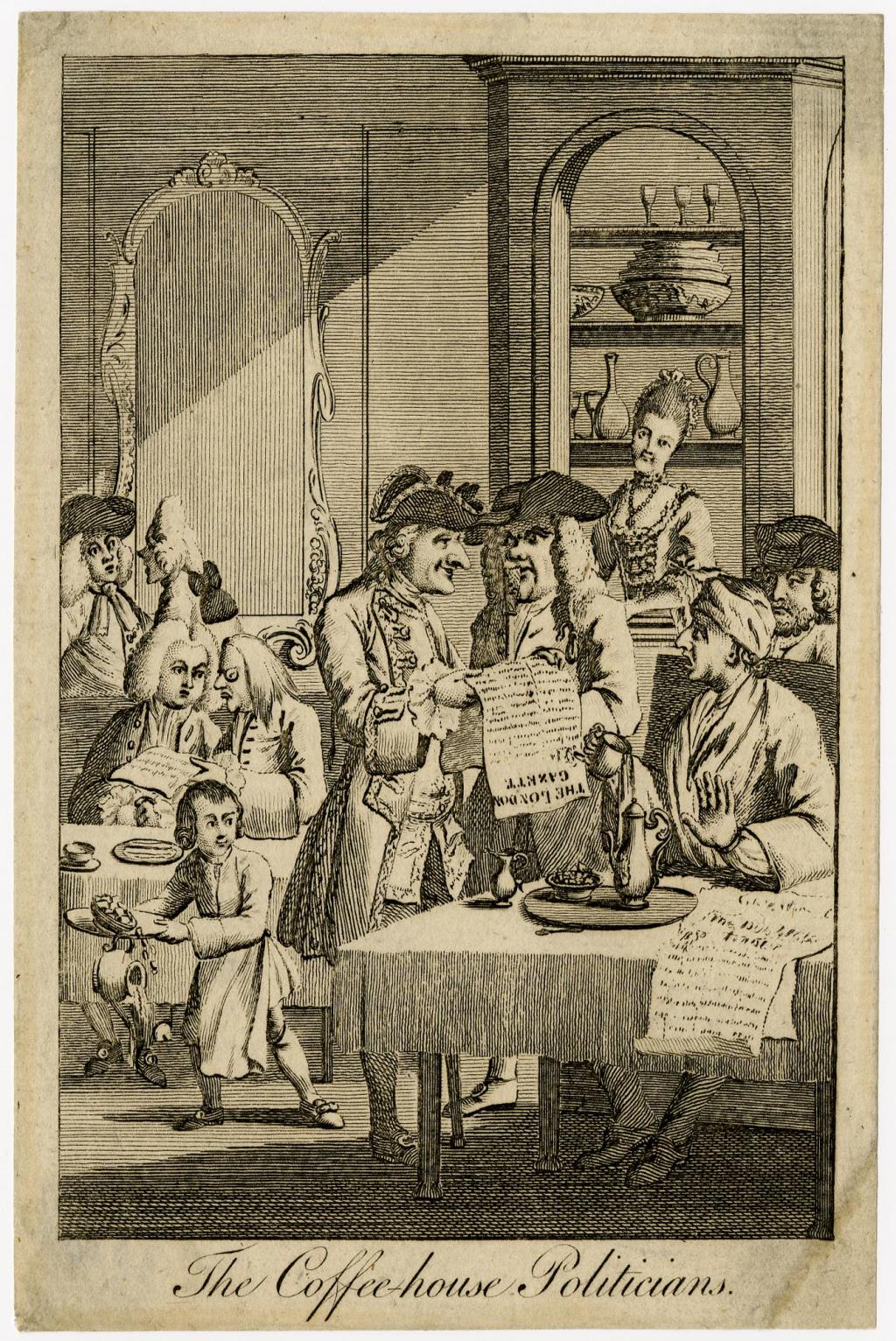 The Coffee House Politicians, by Anonymous after William Hogarth. Etching, 1733. Museum number: 1868,0808.13254. © The Trustees of the British Museum. Shared under a Creative Commons Attribution-NonCommercial-ShareAlike 4.0 International (CC BY-NC-SA 4.0) licence.
Both Addison and Steele had successful runs as politicians and playwrights, and their experience in both arenas heavily informed the prose and content of their future periodical publications. Addison first took public office in 1704, aided by his connections to the social group the Kit-Cat Club, of which he and Tonson were both members.[12] Tonson facilitated the publication of much of his early political writing, which was met with unilateral praise, and Addison became even more central to the literary and political world following the Whig electoral success in 1705.[13] He primarily published political pamphlets, but supplemented this work with forays into plays, operas, and musical theatre. In 1708, he was elected to parliament in London and served as Secretary to the lord lieutenant of Ireland, but by 1710, the broader political ecosystem was once again precarious.[14] However, despite the unknown future of his political career, he was a literary star on the rise, and with the help of Steele, he began arguably the most influential era of his career — his career in news and periodicals.
Steele, on the other hand, began his career as a pamphleteer and playwright, with his first published work appearing in 1695.[15] During his military tenure, he published several different plays, pamphlets, and poems (one in defense of Addison), with his first major success being The Funeral, a stage comedy in 1701.[16] In 1705, Steele settled in London, where he joined the Kit-Cat Club alongside Addison and Tonson and was appointed editor of the London Gazette, the government-sponsored newspaper that was under Whig control at the time.[17] It is likely that Steele obtained the position thanks to Addison, who was working under the Secretary of State Charles Spencer (1674–1722), third earl of Sunderland, at the time. The Gazette was Addison and Steele’s first foray into political writing and periodicals, catalyzing a career that spanned the better part of a decade.
Development of The Spectator
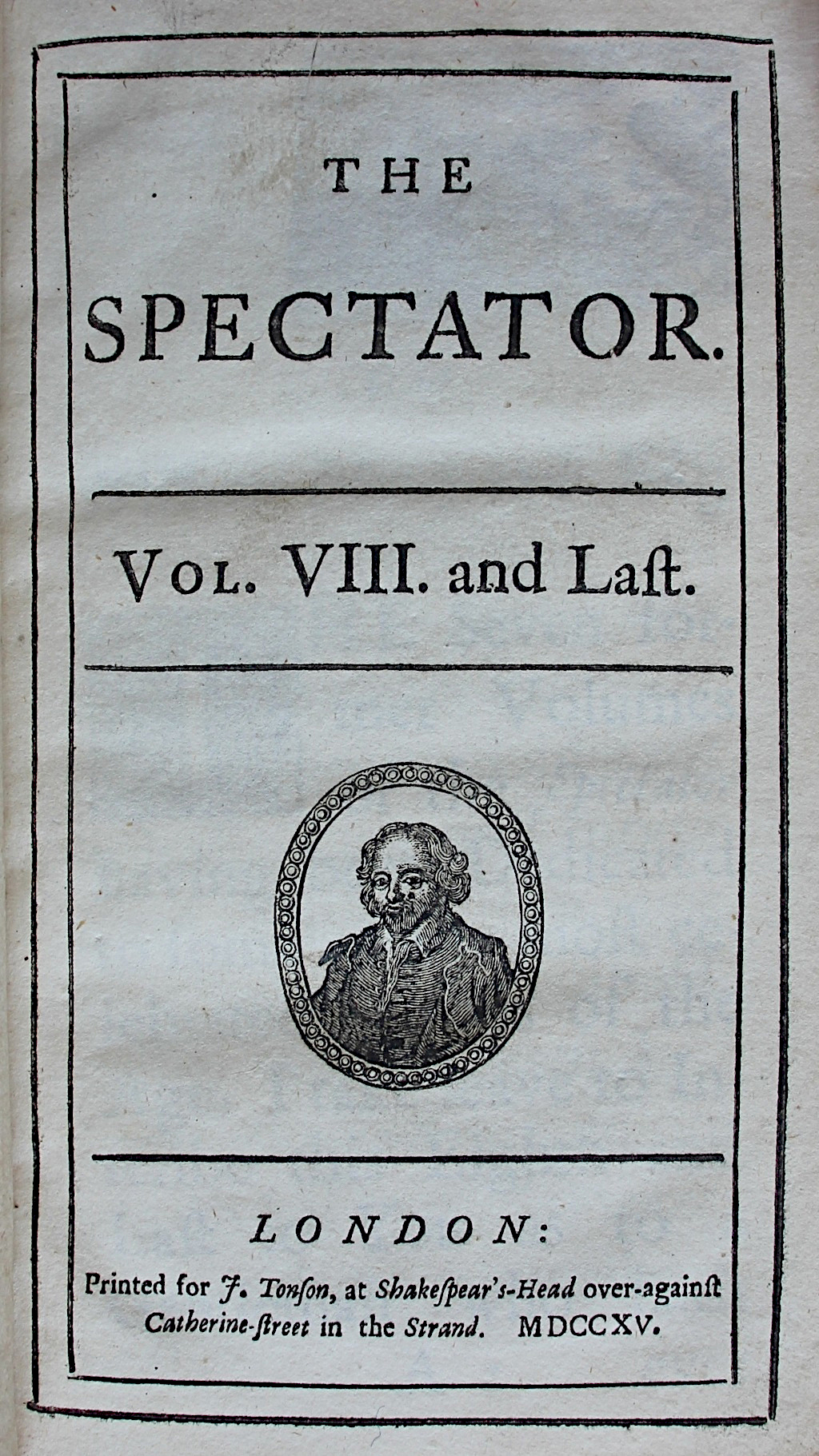 Joseph Addison (ed.), The Spectator, 2nd ed. (London, 1715), viii, title page.
The Spectator initially ran 555 issues between 1711 and 1712, riding the coattails of The Tatler, Addison and Steele’s first joint periodical endeavour. The Tatler began as a kind of news parody, focusing largely on entertainment with a gradual shift towards politics, but The Spectator swore a neutral perspective, likely at Addison’s request.[18] It ran six days a week, narrated by an eidolon called Mr. Spectator, and featured writing from myriad real and fictional authors on a variety of political and cultural issues. In The Spectator no. 10, 10 March 1711, Addison and Steele estimated a circulation of 3,000 copies, though each copy was likely read by many people in coffeehouses around London.[19] Addison is generally recognised to have taken the editorial lead over the paper, though the two largely shared their duties. They formally concluded publication in 1712, but The Spectator was revived solely by Addison for another 80 issues in 1714. Worth’s library contains eight volumes of the second edition of bound volumes of the collected issues, with the exception of the first volume. The first seven of nine volumes were published in 1713 (with volume IV dated from 1714, in an apparent error), and contain the initial 555 issues, while the last two, published in 1715, contain the revival and additional issues.
Development of The Guardian
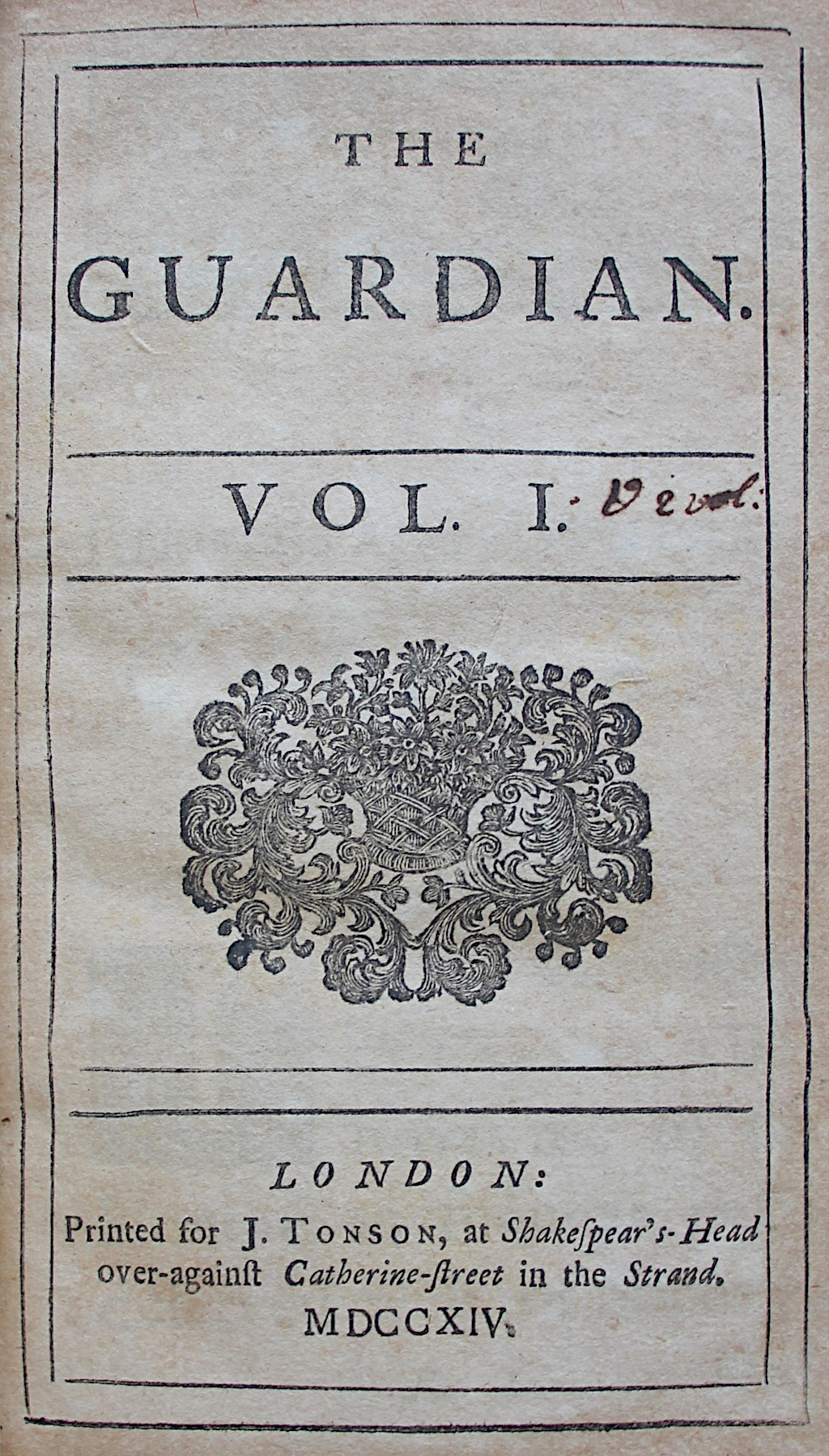 Joseph Addison and Richard Steele (eds), The Guardian (London, 1714), i, title page.
In March 1713, just months after the end of The Spectator, the two launched another periodical, this time with Steele at the helm. The Guardian, appearing six times a week, took a similar form to its predecessor — this time, the eidolon was named Nestor Ironside, and though he was joined by a similar group of fictional writers, The Guardian was far more interested in publishing the writing of other authors, from big contemporary names to readers’ correspondence.[20] The Guardian was overtly partisan and more Whiggish than The Spectator (likely a result of Steele’s hand), and was often caught up in cross-publication political discourse, exacerbated by Steele’s simultaneous rise into public office.[21] Full editorial control was granted to Addison in September of that year, but publication informally and abruptly ceased a month later, shortly after Tory opponent Jonathan Swift (1667–1745) anonymously wrote a targeted takedown of the paper titled The Importance of the Guardian Considered after a published dispute with Steele over the recent Treaty of Utrecht.[22] Worth’s collection contains all 175 issues of The Guardian in two volumes, published in 1714.
A note on the dedicatees
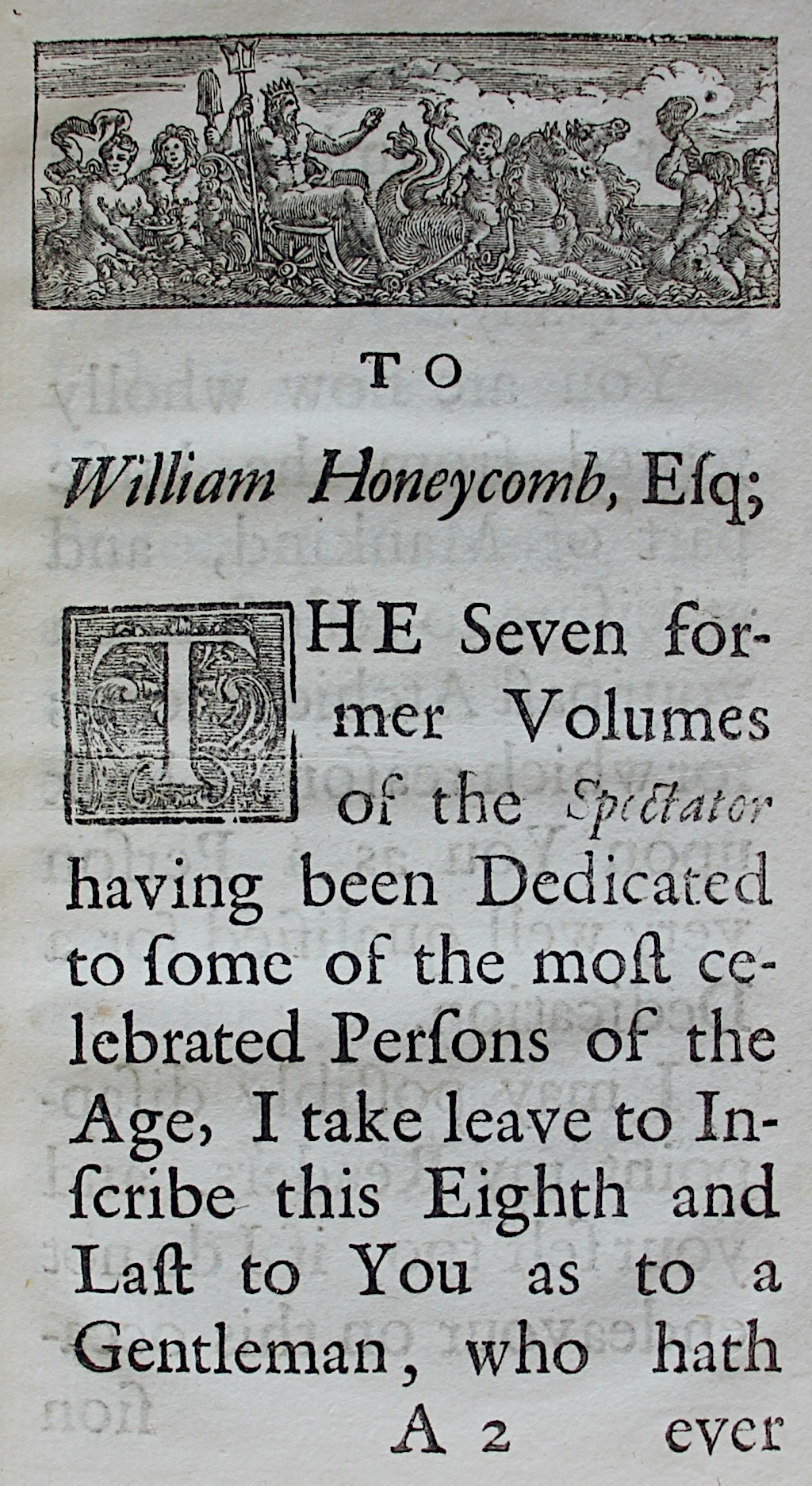 Joseph Addison (ed.), The Spectator, 2nd ed. (London, 1715), viii, Sig. A2r. Dedication to Will Honeycomb.
The volumes’ respective dedications introduce an interesting layer of nuance to the social aims of The Guardian and The Spectator, as most of their dedicatees are esteemed Whig politicians, and were likely identified as potential benefactors or donors to the respective projects. Two volumes are dedicated to various Whig political allies: the second volume to Charles Montagu (1661–1715), earl of Halifax, a Whig statesman who sponsored Addison’s early-career travel and to whom Addison dedicated a 1701 poem; and the eighth to Mr. Methuen, referring to his Whig contemporary and envoy to Portugal Sir Paul Methuen (c. 1672–1757).[23] The third volume is dedicated to the first Duke of Marlborough, referring to John Churchill (1650–1722), an army officer previously celebrated by Addison in his 1705 poem The Campaign.[24] Three volumes are dedicated to lord lieutenants of Ireland and other Irish politicians; the fourth to Henry Boyle (1681×7–1764), earl of Shannon; the fifth to Thomas Wharton (1648–1715), first marquess of Wharton, whom Addison served as secretary to during his tenure as lieutenant; and the sixth to Charles Spencer, earl of Sunderland, whom Addison also worked for as a secretary.[25]
While the links between these six volumes and their respective dedications are logical, the remaining dedicatees of The Spectator are unusual. The ninth volume is dedicated to Mary Belasyse (bap. 1637, d. 1713), Viscountess of Falconberg, likely the daughter of Oliver Cromwell (1599–1658) who strangely died two years before the edition’s publication, and the seventh is dedicated to William Honeycomb, a fictional character and member of the Coffeehouse Club featured in numerous issues of The Spectator, both a stark divergence from the other straightforward recipients.[26]
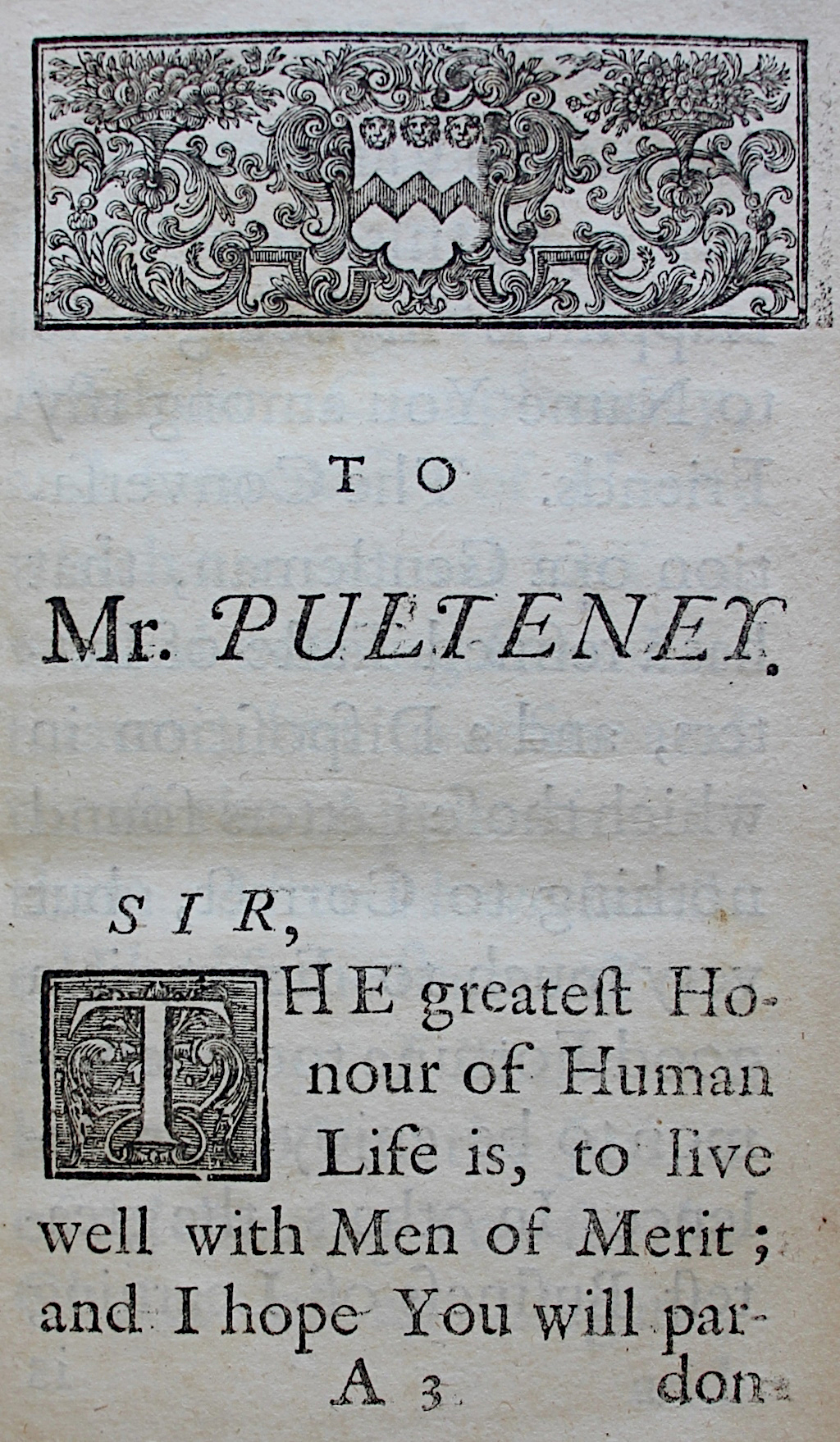
Joseph Addison and Richard Steele (eds), The Guardian (London, 1714), ii, Sig. A3r. Dedication to Mr Pulteney.
The Guardian’s two dedicatees are also directly linked to the political aims of Addison and Steele: the first is dedicated to Mr. Pulteney, referring to William Pulteney (1684–1764), first earl of Bath, and the second is to Lieutenant General Cadogan, referring to William Cadogan (1671/2–1726), earl Cadogan.[27] Both were Whig politicians and contemporaries to the authors, and Cadogan also served in Ireland as a lieutenant during the Williamite wars. These dedications to generally prominent political figures rather than to specific acquaintances reflect the more partisan shift that The Guardian took in contrast to The Spectator.
The importance of the periodical: form and genre
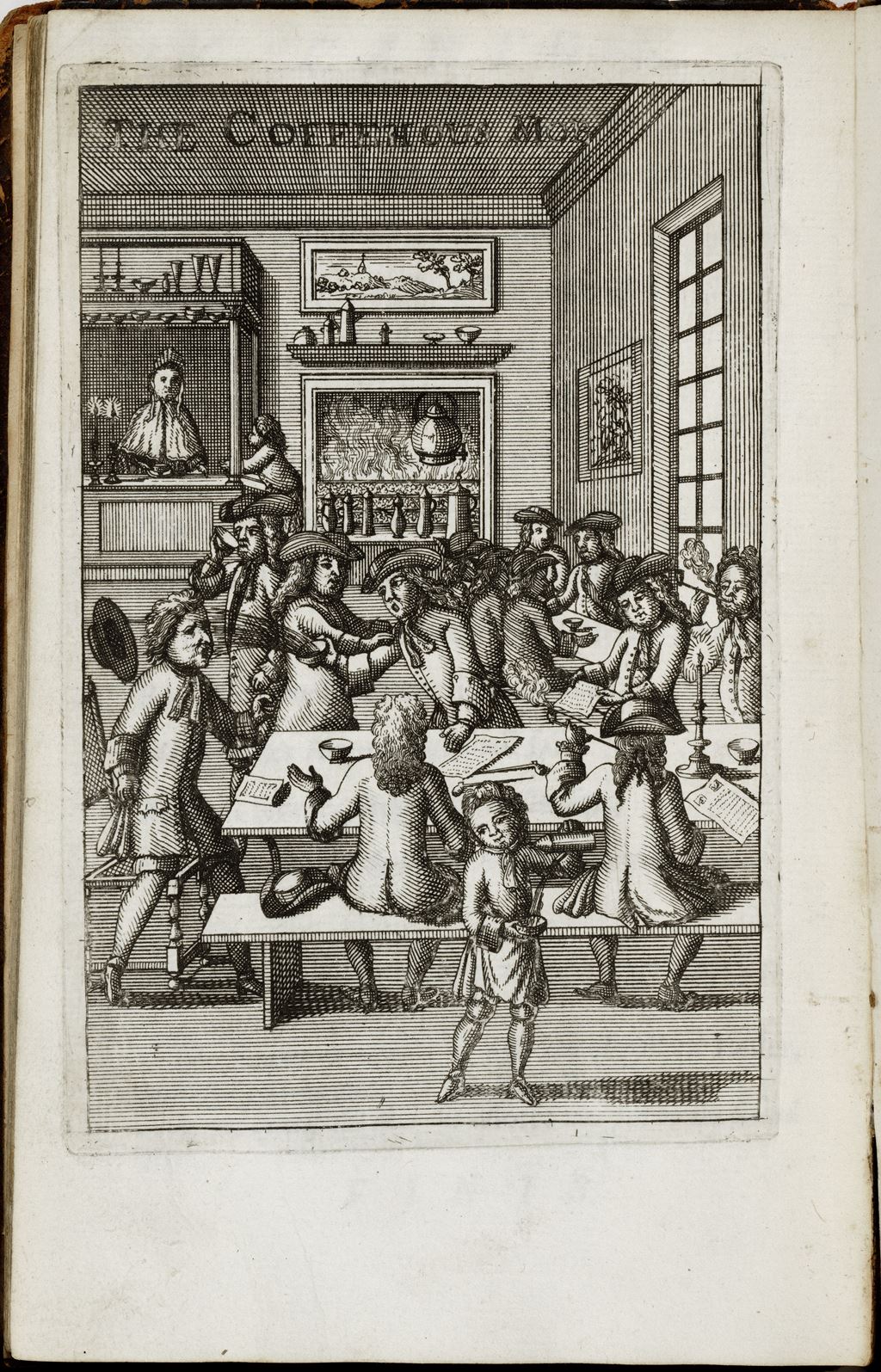
Edward Ward, Vulgus Britannicus, or the British Hudibras. In fifteen canto’s. The five parts compleat in one volume. Containing the secret history of the late London mob; their rise, progress, and suppression by the Guards. Intermix’d with the civil-wars betwixt High-Church and Low-Church, down to this time: being a continuation of the late ingenious Mr. Butler’s Hudibras. Written by the author of the London spy (London, 1710), image of coffeehouse following p. 116. Image credit: Folger Imaging Department.
News media’s material reality at the time of Addison and Steele created the perfect microcosm for their work to flourish. In the late seventeenth century, periodicity became the standard for print news production, replacing their handwritten pamphlet predecessors.[28] The Reformation and the birth and death of the Licensing Act created an opening for the development of mass news production unregulated by the government and with specific partisan commentary.[29] However, following the Jacobite revolution, the public appetite for news became more nuanced. Rather than overtly political commentary, readers sought commentary with a specific moral conviction.[30] In fact, Addison and Steele saw the purely ephemeral daily news as mundane, writing in The Spectator no. 10, 10 March 1711:
‘where the Spectator appears, the other publick Prints will vanish; but shall leave it to my Reader’s Consideration, whether, Is it not much better to be let into the Knowledge of ones self, than to hear what passes in Muscovy or Poland; and to amuse our selves with such Writings as tend to the wearing out of Ignorance, Passion, and Prejudice, than such as naturally conduce to inflame Hatreds, and make Enmities irreconcilable?’[31]
These were the circumstances that Addison and Steele’s The Spectator and The Guardian were born into: a morphing public appetite for current events, paired with rising literacy rates across the middle- and upper- classes in England, the emerging form of the informal essay, and the trend of pseudonymous writing.[32] The periodical therefore appealed to the ephemeral and the salient: it covered current events, be it politics, art, or general social commentary, but it stayed rooted in a more literary tradition.[33] In fact, many periodicals acted as a springboard for current and future major names in English literature, especially for women who were kept out of other avenues for publication.[34] In The Guardian no. 98, 3 July 1713, the authors designate the ‘Paper as a kind of Nursery for Authors’, recognizing its unique ability to recruit others who ‘will hereafter flourish under their own Names in more long and elaborate Works’.[35]
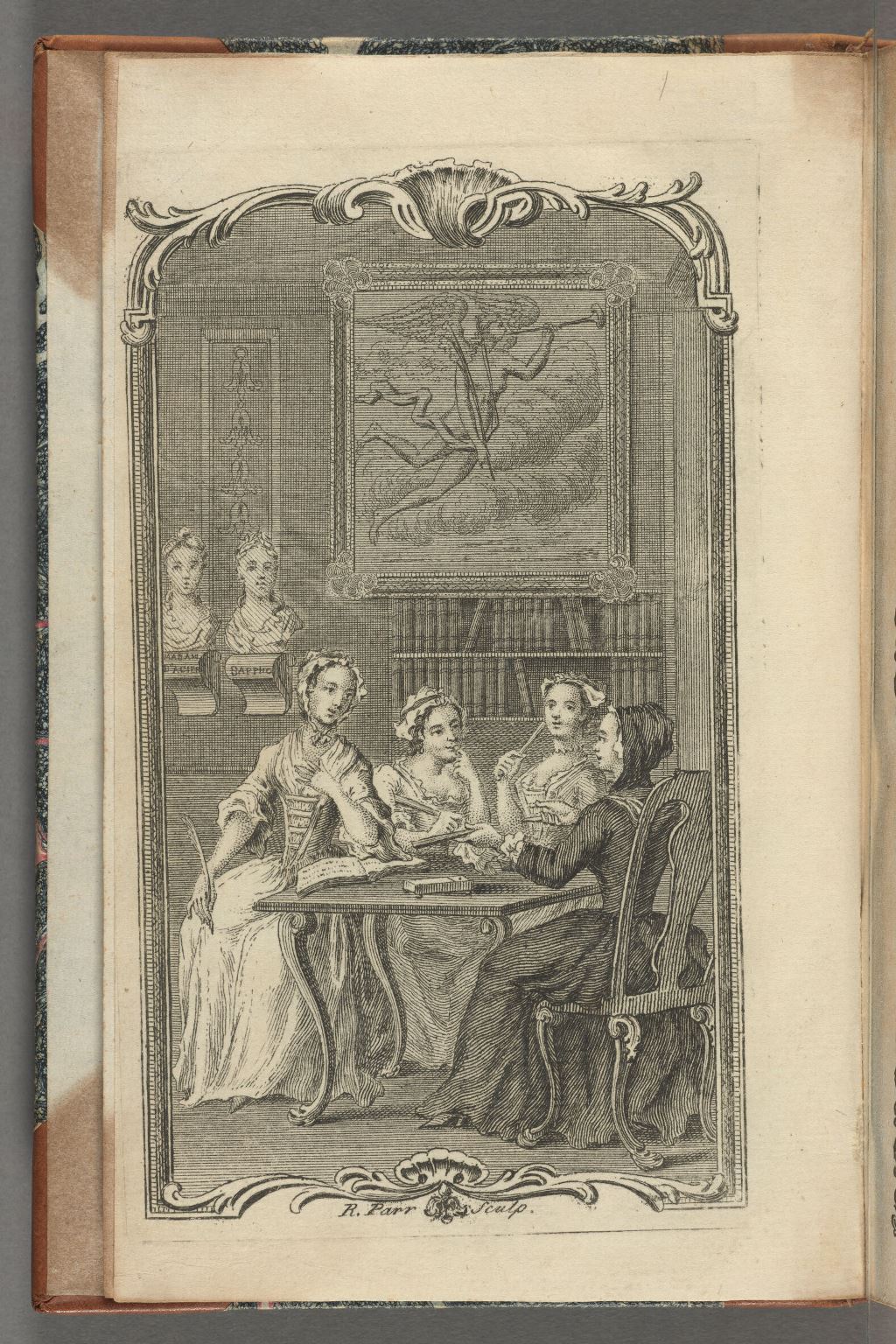 Eliza Fowler Haywood (ed.), The Female Spectator (London, 1746), i, frontispiece. Image sourced from *EC7.H3362.746f, Houghton Library, Harvard University.
Periodicals also sought to expand the reader base of traditional news, which was generally associated with a narrow swath of the male population. They experienced a kind of ‘feminization’ of the news genre, addressing female readers with a level of respectability usually not granted by contemporary literature, and engaging with topics that society would have regarded as traditionally feminine.[36] The Spectator no. 10, 10 March 1711, makes explicit reference to this appeal to women, reading, ‘there are none to whom this Paper will be more useful than to the Female World’.[37] The popularity of The Spectator also brought about Eliza Fowler Haywood’s (1693?–1756) The Female Spectator, a magazine written for women that specifically concerned itself with women’s roles in society, using a similar eidolon ensemble schtick to that of The Spectator itself.[38]
The lines between traditional newspapers and periodicals in the early eighteenth century are blurred as they were often identical in appearance, but they can be distinguished mostly by content and tone.[39] While newspapers were purely occupied with the day’s news, designed to be supplanted by the following issue, periodicals were more literary and intrinsically connected to other issues, keeping their reader base committed to their specific brand and making daily news slightly more perennial.[40] Authors such as Addison and Steele used their periodicals to poke fun at the traditional news genre — such as the use of dateline in their early periodical The Tatler — which further blurred the lines between the two distinct forms and depended on audience familiarity with both to grasp this irony.[41] In this sense, The Spectator engages in what writer Rachael Scarborough King calls a use of ‘materiality to forge a fluid, productive relationship between the emerging and existing genres’.[42] The periodical as a whole depended on the pervasiveness of traditional news, putting itself in ironic conversation by manipulating the form and genre of news production of the time.
The medium of the coffeehouse
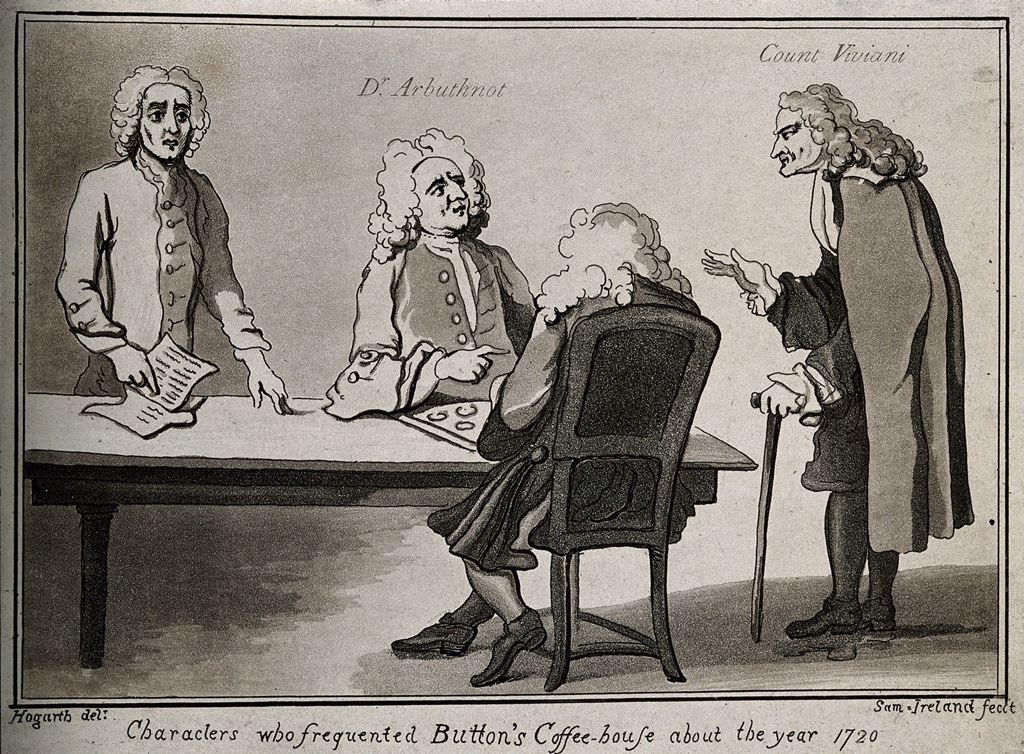 Men playing draughts in Button’s coffee-house. c. 1720. Aquatint by S. Ireland after W. Hogarth. Wellcome Collection. Source: Wellcome Collection.
The popularity of the periodical as a genre was also largely indebted to the emergence of the coffeehouse and the broader ‘public sphere’ during the early 18th century.[43] London’s development into its early modern metropolitan form and the expansion of the middle class brought with it the demand for modern public space.[44] The coffeehouse served this need as a forum for public debate, recognised by Addison and Steele in The Spectator no. 197, 16 October 1711, as the narrator recalls ‘a calling in lately at one of the most noted Temple Coffee-houses’, in which he discovers ‘the whole Room, which was full of young Students, divided into several Parties, each of which was deeply engaged in some Controversy’.[45] In turn, these spaces became an agent in the broader development of news publication, with coffeehouse owners often subscribing to periodicals themselves to increase patronage.[46] Periodicals and other forms of serial news were sometimes penned, disseminated, and consumed all within the venue of the coffeehouse.
Addison and Steele’s work was instrumental in the integration of the periodical as a whole into new public social infrastructure. The routine of serial news encouraged regular patronage to these spaces, where issues were shared by at least twenty readers per copy, a ‘modest Computation’ estimated by Addison in The Spectator no. 10, 10 March 1711.[47] Locations such as The Grecian Coffee House, Saint James Coffee House, and Button’s Coffee House were all frequented by Addison and Steele and were central to the distribution of their many periodicals, with the latter hosting much of the production process of The Guardian itself.[48]
Addison and Steele were quick to recognise how instrumental these spaces were to the proliferation of their work, and made regular reference to them as well as to their general occupants. In The Spectator no. 49, 26 April 1711, the narrator Mr. Spectator writes:
‘It is very natural for a Man who is not turned for Mirthful Meetings of Men, or Assemblies of the fair Sex, to delight in that sort of Conversation which we find in Coffee-houses. Here a Man, of my Temper, is in his Element … the Coffee-house is the Place of Rendezvous to all that live near it, who are thus turned to relish calm and ordinary Life’.[49]
Throughout The Spectator’s long run, the periodical featured a host of fictional characters meant to embody the archetypes of a coffeehouse of the time — called Mr. Spectator’s Coffee House club, the group was led by the pseudonymous narrator and was meant to highlight the vast array of characters in the budding metropolis. Mr. Spectator, a well-educated aristocrat who subtly reflected the Whig politics of both his authors, is joined by other characters such as Sir Andrew Freeport, a personification of entrepreneurship and trade; Eubulus, a bourgeois figure with considerable social sway within the coffeehouse, and Will Honeycomb and Betsy Bentick, both analogs for sexual liberation within the public sphere, among many others.[50] While these characters certainly distinguished The Spectator from other, more objective serial news of the time, they also played into the broad theatrical tendencies of the periodical and added a dimension of introspection and metacommentary.
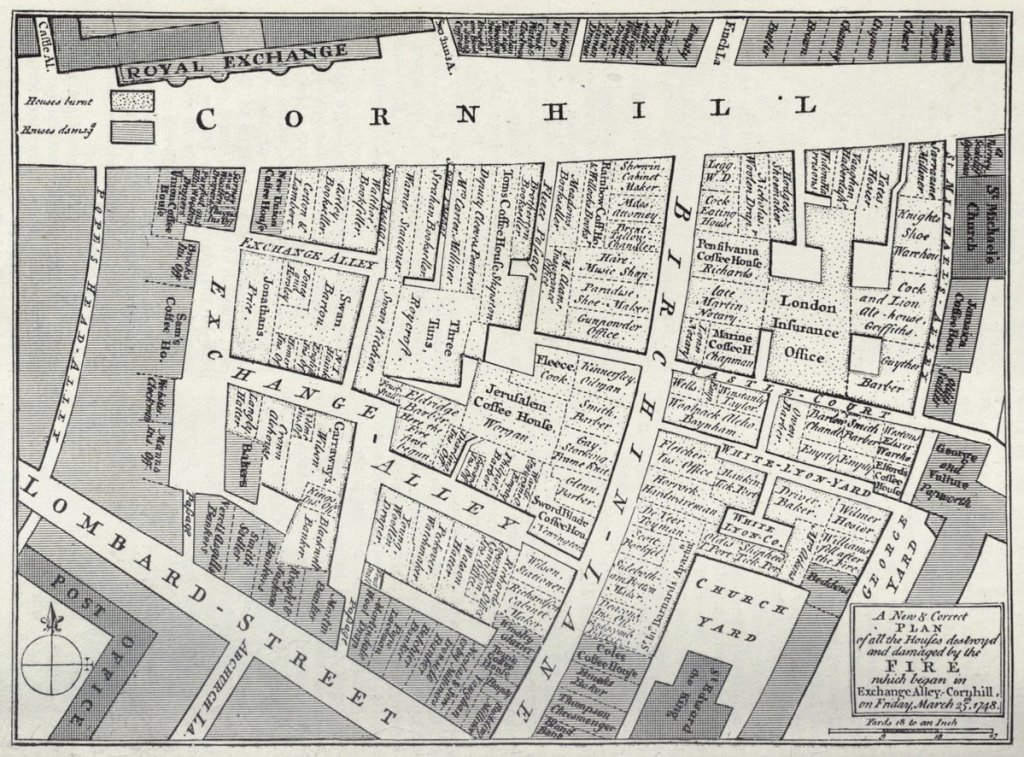
‘A New and Correct PLAN of all the Houses destroyd and damaged by the FIRE which began in Exchange Alley, Cornhill, on Friday, March 25th, 1748’. Reproduced in William Harrison Ukers’ All About Coffee (New York, 1922). Image sourced from the Public Domain Image Archive / Internet Archive / University of Toronto Libraries.
Theorist Jurgen Habermas suggested that these coffeehouses epitomised the expansion of the ‘bourgeois public sphere’ in the early modern period, a venue for the kind of polite sociability that Addison and Steele wished to cultivate.[51] These coffeehouses — and the periodicals disseminated within them — facilitated the development of a public entity outside the state, one which encouraged leisurely debate and public discussion in conjugation with the rising news industry.[52] According to scholar Brian Cowan, the coffeehouse gave Addison and Steele the opportunity to serve specific Whig political interests by carefully crafting a physical space that was a ‘respectable alternative’ to the Tory platform belief that only the ‘Church of England can offer a solid foundation for the moral revitalization of society’.[53] He wrote that The Spectator’s ideal coffeehouse ‘was a carefully policed forum for urban but not risque conversation, for moral reflection rather than obsession with the news of the day or the latest fashions, and for temperate agreement on affairs of state rather than heated political debate’.[54] Whether or not Addison and Steele’s venue of the coffeehouse was an organic employment of a popular new space, or regulated venue carved to serve a specific political interest, its role in the continued legacy of their periodicals cannot be overstated.
The power of the pseudonym
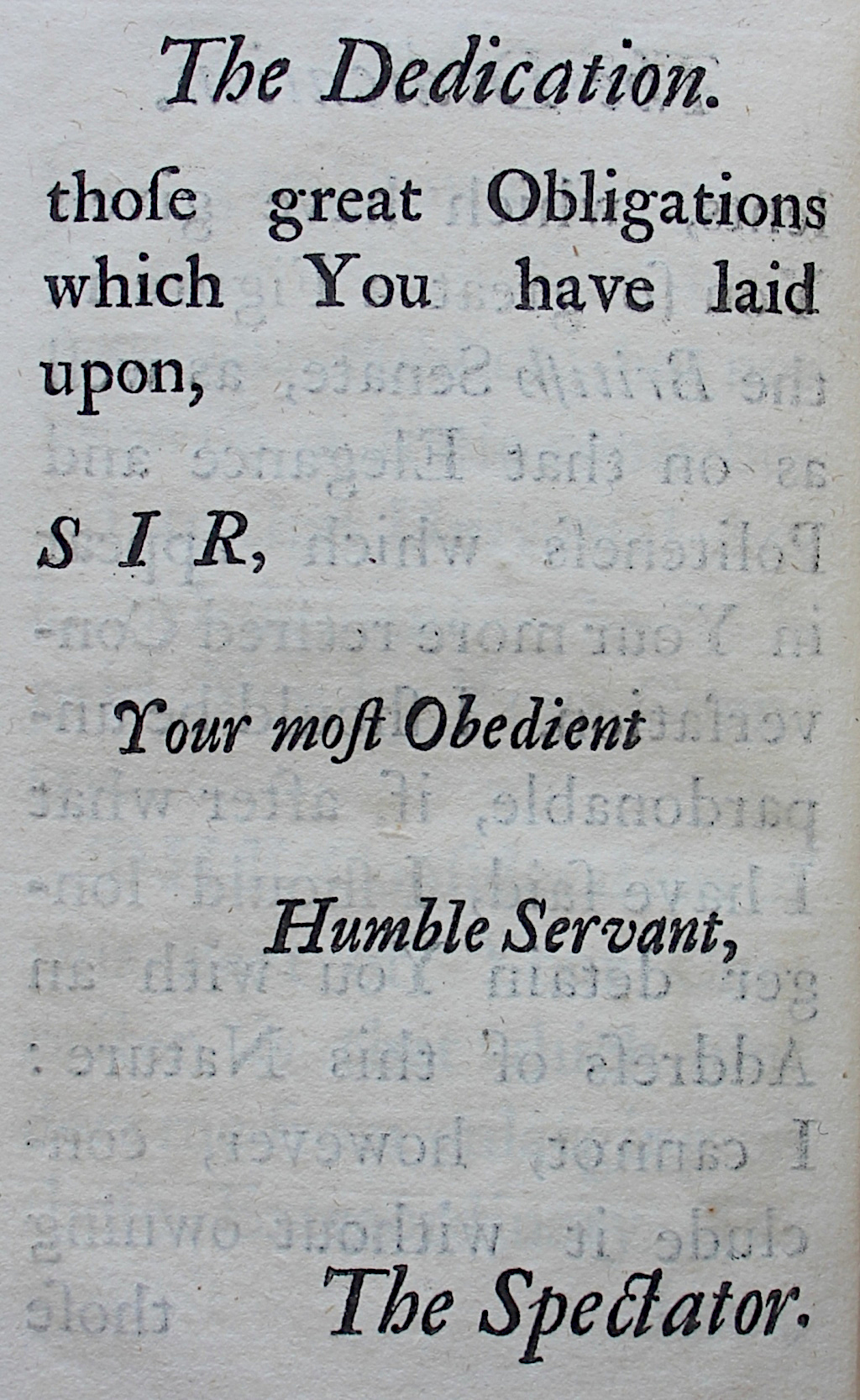 Joseph Addison and Richard Steele (eds), The Spectator, 2nd ed. (London, 1713), iii, Sig. A4v. Dedication signed by Mr. Spectator.
Addison and Steele’s periodical work was further distinguished from traditional news through their use of pseudonymous narrators. This model, originating with the narrator Isaac Bickerstaff in their earlier publication The Tatler, functioned to both further engage readers and to act as a mask for authors, playing into the broader theatrical projects of their periodicals. Mr. Spectator served as a kind of neutral observer — as detailed in no. 1, 1 March 1711, he was nestled in aristocracy and politics, so his voice carried authority, but he provided a morally instructive perspective rather than acting as a dictator on the proper social gaze.[55] Upon introducing himself in the first issue, Mr. Spectator writes, ‘I live in the World, rather as a Spectator of Mankind, than as one of the Species, by which Means I have made my self as Speculative Statesmen, Soldier, Merchant and Artizan, without ever meddling with any Practical Part in Life’.[56]
Mr. Spectator recognised that his anonymity was a service to the paper, as it kept readers more engaged. He could act as an aggregate of a wide variety of beliefs, not tied down to the actual ideological leanings of his authors.[57] He recognises this bipartisan advantage in no. 179, 25 September 1711, writing: ‘I make it therefore my Endeavor to find out Entertainments of both Kinds, and by that means perhaps consult the Good of both’.[58] He continues, ‘The Reader sits down to my Entertainment without knowing his Bill of Fare, and has therefore at least the pleasure of hoping there may be a Dish to his Palate … if we will be useful to the World, we must take it as we find it’.[59]
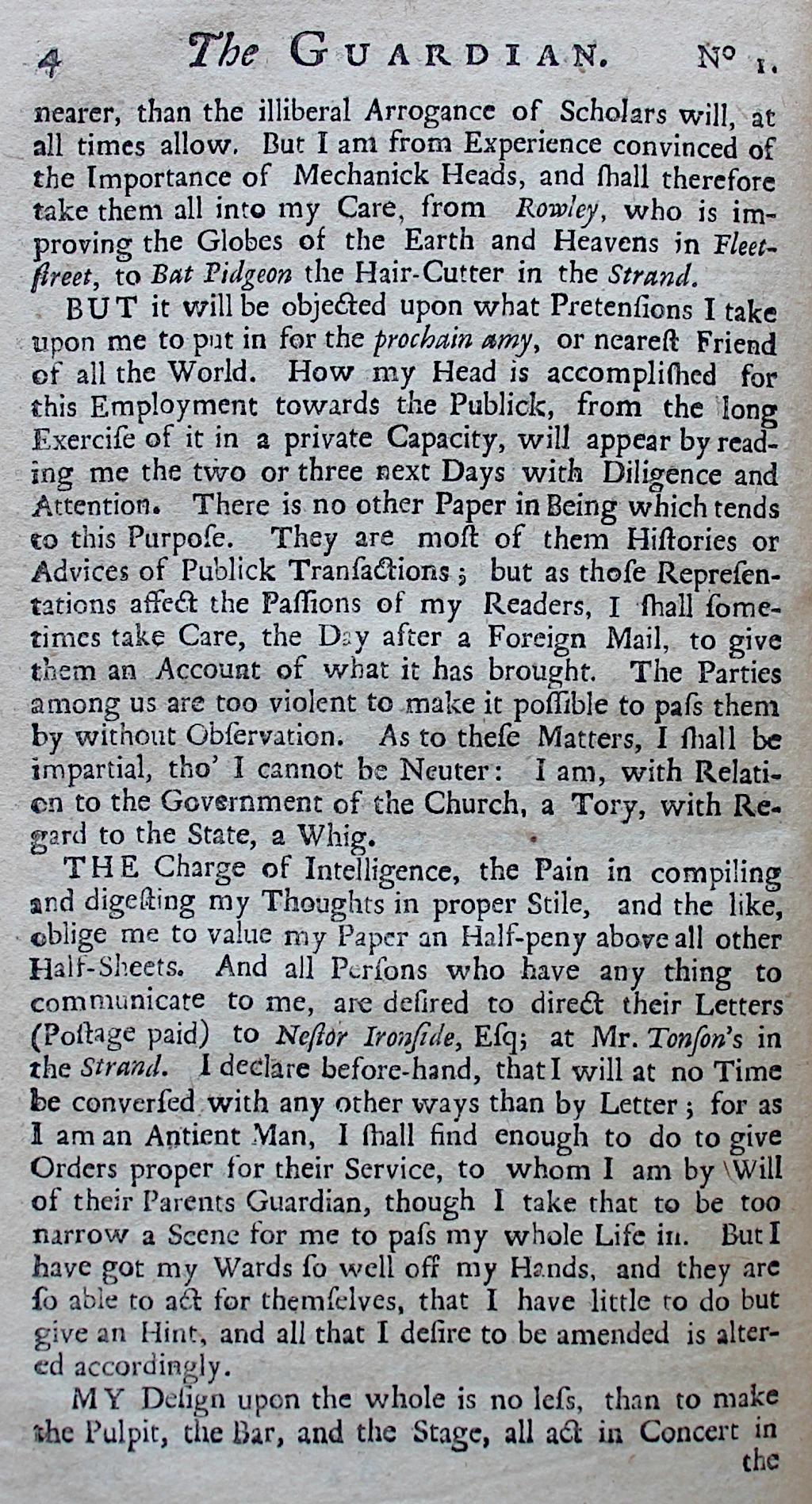 Joseph Addison and Richard Steele (eds), The Guardian (London, 1714), i, 4. Nestor Ironside encourages readers’ correspondence.
Readers could also scour the pages for hints at his true identity, and were encouraged to engage regularly and carefully to uncover more clues about the periodical’s real authors.[60] The pseudonym’s connection to the real social sphere with which he was embedded also encouraged audiences to patronize coffeehouses and to correspond with Mr. Spectator and The Guardian’s eidolon Nester Ironside through written letters to the publication.[61]
Although the real authors’ identities were not entirely secret, this kind of literary mask played into the dramatics that Addison and Steele regularly employed. Mr. Spectator recognised this theatrical project early on in the periodical’s run, writing that he considers the ‘World as a Theatre and desires to form a right Judgment of those who are the Actors on it’.[62] The authors became characters within a fictional world that paralleled reality, granting them what writer Ionia Italia calls an ‘ironic distance’ and letting them ‘treat their alter egos with self-depreciatory humor, while still retaining their own dignity and credibility as social commentators, educators or moralists’.[63] It was a satirical safety net for authors interested in both broad appeal and protecting their reputations, a neutral canvas onto which readers could project their own ideology.[64]
Correspondence with readers
By combining the popularity of the coffeehouse and the allure of their pseudonymous narrators, Addison and Steele elevated the dramatics of their periodicals by directly engaging with their readership. Giving their readers the opportunity to write letters (often published in both The Guardian and The Spectator), they could then take on characters of their own and participate in this quasi-dramatic endeavour.[65] Both periodicals created a theatrical event so successful that it expanded beyond simply the eidolons and debates on the page into a complete artificial world maintained by its readership.[66] Margaret J. M. Ezell calls this phenomenon an early-modern iteration of a ‘participatory social media event’, arguing that these sustained author-reader relationships solidified Addison and Steele’s work as a ‘literary brand’ in comparison to some of their contemporaries.[67] Readers felt as if they were a part of the world of Addison and Steele, both encouraging their continued material engagement but also their introspection into and identification with the commentary that the periodicals provided.[68]
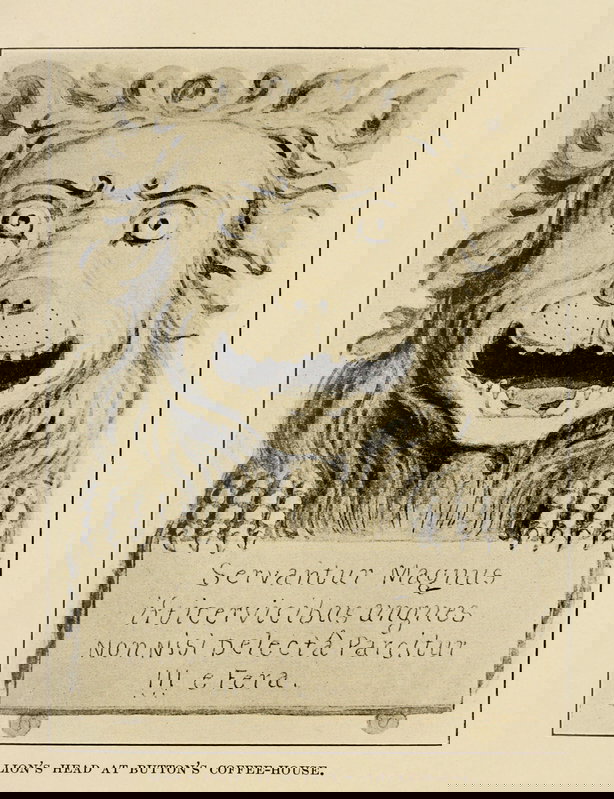
The Lion’s Head at Button’s Coffee-House. Reproduced in William Harrison Ukers’ All About Coffee (New York, 1922). Image sourced from the Public Domain Image Archive / Internet Archive / California Digital Library.
In particular, The Guardian was able to combine this interest in author/reader correspondence and the milieu of the coffeehouse to maintain a participatory brand. Button’s Coffeehouse, located in Covent Garden, was the primary site of Addison’s authorship of The Guardian and also the receiving-house for all reader submissions to the paper.[69] Button’s was home to a letter-box in the shape of a lion’s head, into which readers could feed various submissions that would be published in a special weekly edition of The Guardian titled The Roarings of the Lion.[70]
In announcing the creation of the lion’s head, Addison wrote in The Guardian no. 114, 22 July 1713, ‘my Lion, like a Moth or Book Worm, feeds up-on nothing but Paper, and shall only beg of them to Diet him with wholesome and substantial Food. I must therefore desire that they will not gorge him either with Nonsense or Obscenity; and must likewise insist that his Mouth not be defiled with Scandal’.[71] By inviting its readers to engage in role-playing of their own, Addison codified audience participation as an essential component of the theatrical spectacle of The Guardian, ensuring that the social milieu in which it was embedded was never obscured by the published material.[72]
The dramatization of political discourse
The Spectator was in constant discourse with other newspapers, parodying the medium despite actively engaging with it.[73] Much of the previously-mentioned satire of Addison and Steele’s periodicals was meant to critique the form itself, a nuance that King writes cannot simply be understood as ‘ironic inversion’, but rather as using ‘materiality to forge a fluid, productive relationship between the emerging and existing genres’.[74] This meta-satire, wherein the periodical took on the role of a news source while actively critiquing the medium, ensured that every reader of The Spectator was playing a part in this dramatised version of news production.
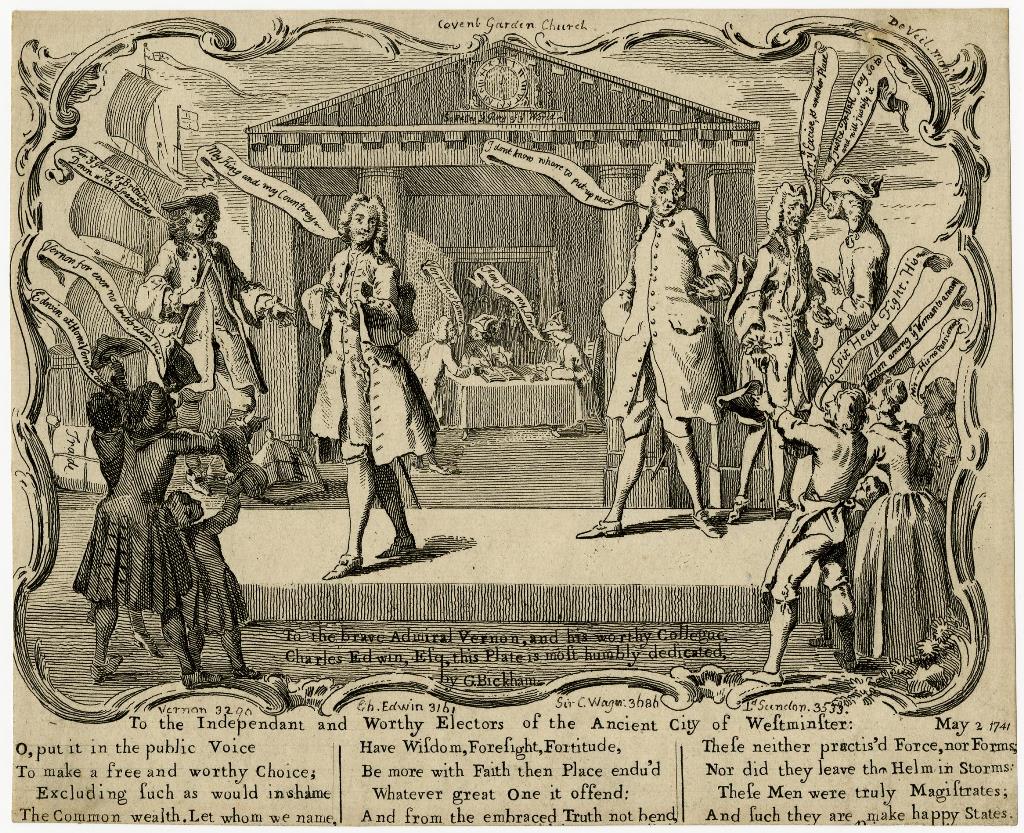 Satire on the Westminster Election of May 1741 showing the four candidates of the hustings in front of the portico of St Paul’s, Covent Garden. Etching, 1741. Museum number: 1868,0808.3663. © The Trustees of the British Museum. Shared under a Creative Commons Attribution-NonCommercial-ShareAlike 4.0 International (CC BY-NC-SA 4.0) licence.
The Spectator’s perpetual performance of the news was further enhanced by its use of characters and analogs to spell out political discourse of the time and to take political stances. After using the first few issues of the periodical to explain the nuances of Mr. Spectator (a character who plays a part in this theatrical exercise in his own right), Addison and Steele use The Spectator no. 3, 3 March 1711, to articulate their position on public credit, depicting it as a ‘beautiful virgin, seated on a throne of gold’, who, ‘according to the News she heard, to which she was exceedingly attentive, she changed Colour, and discovered many Symptoms of Health or Sickness’.[75] While she constantly comes under threat, she maintains her strength with the support of other symbolic figures. Charles A. Knight describes this characterization as a ‘witty extension’ of an already existing trope, writing that ‘the unstable image of Public Credit is subsumed in the benevolent portrait of commercial society which treats national debt as a patriotic obligation of moneyed individuals’.[76] By playing on traditional dramatic tropes such as a virgin in distress, Addison and Steele are able to articulate their political stance through theatrical archetypes.
In fact, The Spectator regularly employed emotionally provocative imagery of women to further its political agenda. Steele uses this language much more literally in later issues of the periodical, namely in essays covering prostitution. In The Spectator no. 266, 4 January 1712, the narrator encounters a ‘slim young girl of about Seventeen’ on the street.[77] The narrator identifies himself as ‘wholly unconcerned in any scene I am in, but meerly as a Spectator’, and given this perspective, he could ‘observe as exact Features as I had ever seen, the most agreeable Shape, the finest Neck and Bosom, in a Word, the whole Person of a Woman exquisitely Beautiful’.[78] Through this characterization, Steele and Addison are able to use the theatrical framing of an observer to unite their readership through what Anthony Pollock calls an ‘identification with a surrogate spectator who models the proper affective reaction to images of violated women’.[79] Once again, The Spectator uses provocative, dramatised imagery, but in this instance to model social behaviour, not simply to create political allegory.
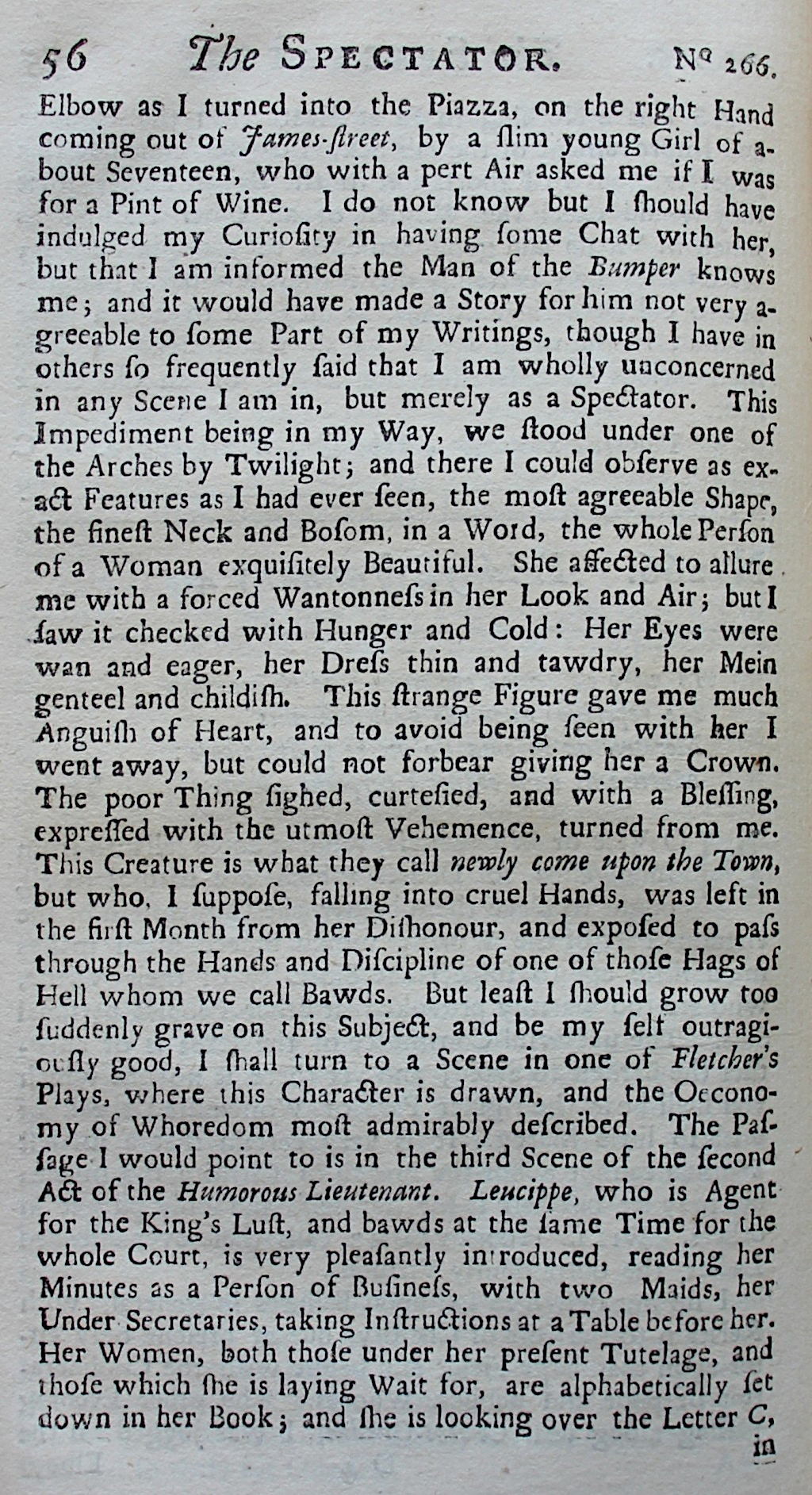 Joseph Addison and Richard Steele (eds), The Spectator, 2nd ed. (London, 1714), iv, 56.
This characterization of women as moral and political props became some of their most salient work in The Spectator. In no. 11, 13 March 1711, they tell the story of Inkle and Yarico, in which an English trader falls in love with a Native American woman, whom he later sells in slavery in exchange for his desired social status. The anecdote is an exercise in the virtue of the emerging middle class — a meditation on the moral bankruptcy of trade moguls while using Yarcio as a provocative analog to mull over the virtuosity of Inkle.[80] The story was adapted into a play in 1787, demonstrating the effectiveness of the periodical as a theatrical project and also as a moral dissection on upper-class virtues.[81]
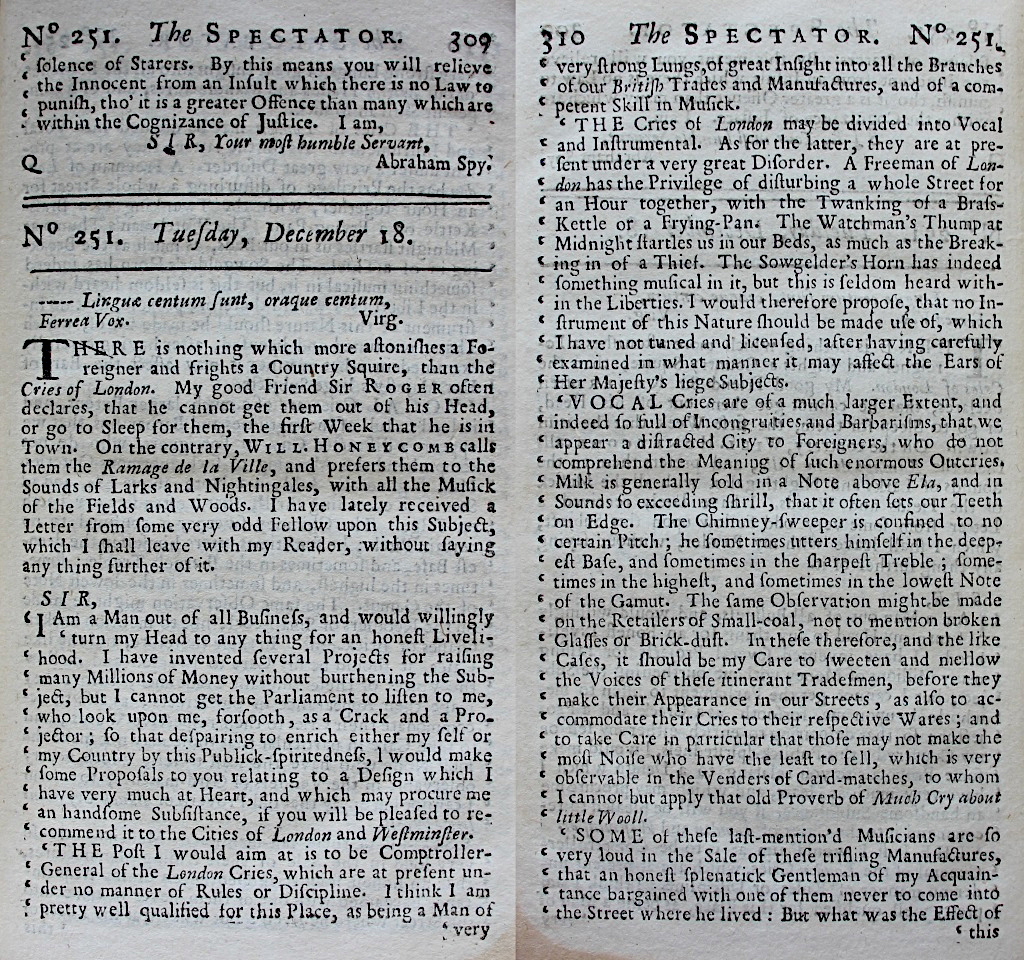 Joseph Addison and Richard Steele (eds), The Spectator, 2nd ed. (London, 1713), iii, 309–310. Cries of London.
The city of London itself is also characterised in dramatic terms to accurately describe its contemporary state. In The Spectator no. 251, 18 December 1711, Mr. Spectator and a fictional reader by the name of Ralph Crochet both use musical and theatrical language to describe the cacophony of the bustling urban hub. ‘Cries of London’ describes the sounds of the city as if they were a symphony in performance: ‘The Watchman’s thump at Midnight startles us in our Beds’; ‘the Cooper in particular swells his last note in an Hallow voice, that is not without its Harmony’; ‘the Chimney-Sweeper is confined to no certain Pitch; he sometimes utters himself in the deepest Base, and sometimes in the sharpest Treble’.[82] The piece goes further to illustrate the transformation of the city, writing recognizing those ‘who, not contented with the traditional Cries of their Forefathers, have invented particular Songs and Tunes of their own’.[83] Here, The Spectator once again emphasises its dramatic basis by painting the entire city — and the growing public and economic spheres to which it owes its success — in terms of a complex performance. Knight identifies this description as ‘energizing the London scene that the Spectator observes, celebrates, and embodies’.[84]
Drama criticism and critique of “high art”
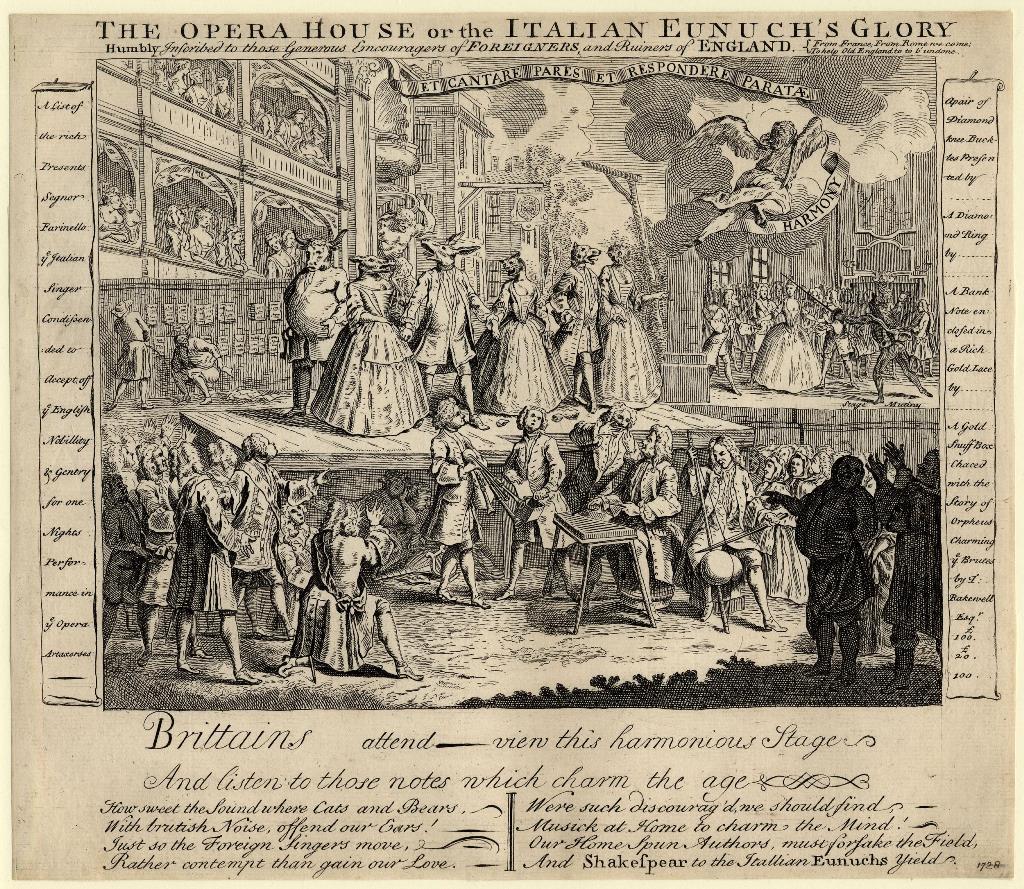 The Opera House or the Italian Eunuch’s Glory, by Anonymous after William Hogarth. Etching, 1735. Museum number, 1868,0808.3526. © The Trustees of the British Museum. Shared under a Creative Commons Attribution-NonCommercial-ShareAlike 4.0 International (CC BY-NC-SA 4.0) licence.
Addison and Steele did not just engage with theatre through their own constructions, however, as drama criticism was a major component of their content, primarily in The Spectator. They extended criticism to almost every form of theatre under the sun, as well as to both drama as a whole and criticism as an entity itself. In the revived version of The Spectator no. 592, 10 September 1714, Mr. Spectator underlines the importance of the theatre, writing ‘I look upon the play as a World within itself’, as well as the value of thoughtful criticism.[85] He writes that ‘The Ancient Criticks are full of the Praises of their Contemporaries; they discover Beauties which escaped the Observation of the Vulgar’, contrasting this perspective with the contemporary ‘Smatterers in Criticism who appear among us, make it their Business to vilifie and depreciate every new Production that gains Applause’.[86]
Much of The Spectator’s general theatrical criticism was relegated to opera, which Mr. Spectator criticised due to its foreign language and appeal to irrational emotion rather than rational thought.[87] In The Spectator no. 18, 21 March 1711, he was concerned that we ‘no longer understand the Language of our own Stage;’ which may facilitate Italian actors ‘calling us names and abusing us among themselves’, as the foreign language gives them the opportunity to ridicule audiences ‘with the same Safety as if it were behind our backs’.[88] He also worried that the genre appealed too much to emotion, writing ‘Musick is certainly a very agreeable Entertainment but if it would take the entire Possession of our Ears … it would make us incapable of hearing Sense’.[89] Addison and Steele express similar criticism in regard to tragedy,[90] as they have a distaste for the genre’s use of costuming and set dressing to evoke an emotional reaction rather than words themselves.[91]
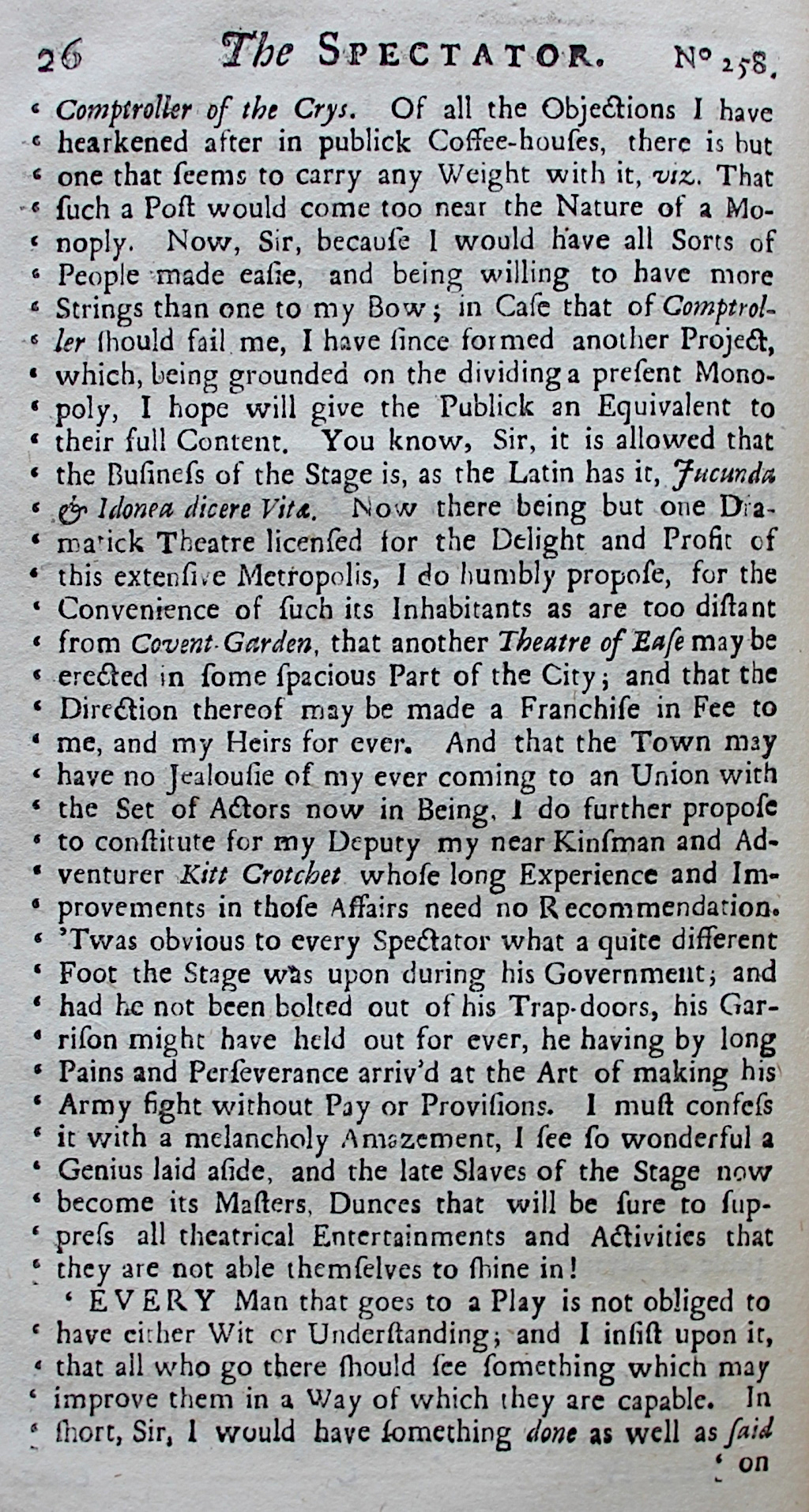 Joseph Addison and Richard Steele (eds), The Spectator, 2nd ed. (London, 1714), iv, 26. Correspondence on the subject of the stage.
The Spectator also emphasises Addison and Steele’s philosophy on the moral and social function of theatre, indicated through correspondence with Ralph Crochet in no. 258, 26 December 1711, which reads, ‘all who go there should see something which may improve them in a Way of which they are capable. In short, Sir, I would have something done as well as said on the Stage’.[92] The art has a duty to be morally and socially instructive — to transform the audience, rather than just entertain them.
In The Guardian no. 1, 12 March 1713, Addison identifies the theatre as one of the primary focuses of the new periodical, writing ‘My Design upon the whole is no less, than to make the Pulpit, the Bar, and the Stage, all act in Concert in the Care of Piety, Justice, and Virtue’.[93] However, this paper was far less dedicated to criticism than that of predecessors, with only ten issues mentioning the theatre, and many of them dedicated to Addison’s own play Cato.[94] Notably, in The Guardian no. 59, 19 May 1713, Cato is praised in a published letter from character William Lizard for its moral instruction: ‘such virtuous and moral Sentiments were never before put in the Mouth of a British Actor; and I congratulate my Countrymen on the Virtue they have shown in giving them (as you tell me) such loud and repeated Applauses’.[95]
Addison and Steele were also concerned with the national state of taste and high art, and, as Peterson observes, specifically condemned ‘the poor taste of extravagance’.[96] In another parallel between theatre and politics, Addison and Steele compared gratuitous excess on stage to pointless military spending, combining both forms of criticism to slight both areas of their coverage.[97] To them, taste was indicative of not just social status but of individual character and therefore they acted as guides and critics of the broader taste of middle-and upper- class society. Here, Cato is praised for its proper moral instruction and for its indication that its audience is morally upright. As Knight writes, ‘For the Spectator, therefore, the achievements of art — with all of their questionable aspects — attest both national wealth and the specialised skills that make the achievement of wealth possible’.[98] Criticism of theatre and taste was not just a form of entertainment, but also a material means of gauging economic and military policy.
The downfall of The Guardian
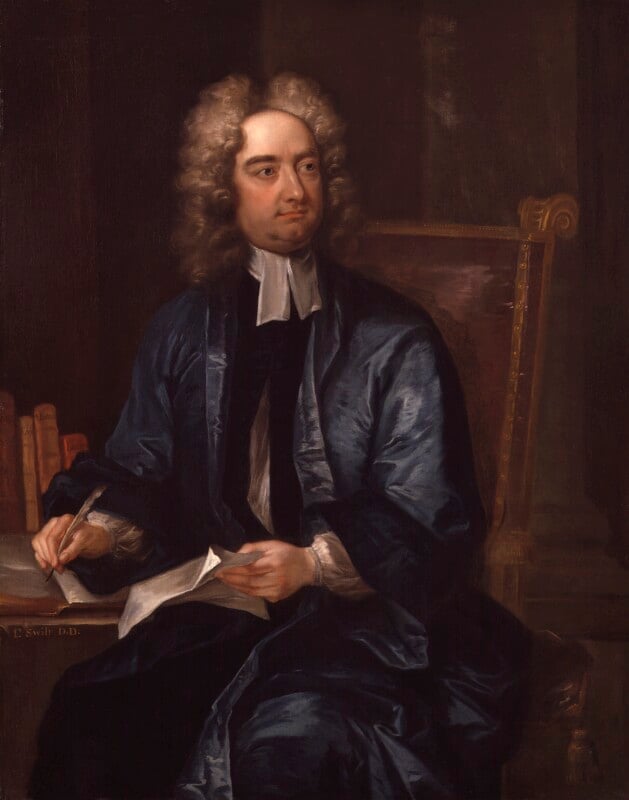 Jonathan Swift, by Charles Jervas. Oil on canvas, c. 1718. NPG 278. © National Portrait Gallery, London.
The ultimately abrupt end to The Guardian’s publication can also be read as a form of political theatre, albeit a different mode. In keeping with Addison and Steele’s imagination of the periodical as a kind of stage, heated partisan disputes were often carried out on its pages. Much of this discourse took the form of critical letters-to-the-editor,[99] featured in The Guardian’s many issues of reader correspondence, but the periodical’s abrupt ending can ultimately be seen as a result of a cross-publication dispute between Steele and former contributor Swift.[100] In mid-1713, Steele began to use The Guardian as an outlet for harsher partisan polemics, specifically concerning the recent and controversial Treaty of Utrecht.[101] Shortly after, he took a seat as a member of parliament, transferred complete editorial control of the paper to Addison, and began to publish the exclusively political paper The Importance of Dunkirk Consider’d.[102]
As a part of an extremely public takedown of Steele, Swift anonymously published The Importance of the Guardian Considered, a takedown of both Steele’s publication and his politics, writing, ‘He allows us to be his criticks, but not his answerers; and he is altogether in the right, for there is in his letter much to criticised, and little to be answered’.[103] After this scathing and extremely public attack, Steele permanently halted publication of The Guardian. He continued his writing career with several other partisan pamphlets, none reaching the success or securing the legacy of The Tatler, The Spectator, or The Guardian.[104] Ultimately, The Guardian was a casualty of the political theatrics Addison and Steele sought so hard to cultivate.
Conclusion
Addison and Steele led the way in transforming news production in the early eighteenth-century, experimenting with the form and genre as they carved a social space for its creation and consumption. The Edward Worth Library’s collection of their various periodicals illuminates their profound discourse, as both authors combine their skillsets in theatre and politics to imagine contemporary discussion. Their levelling of criticism and arguing for reform through dramatic literary scenes transformed the literary landscape, and their use of personified analogs to emphasise their rhetoric had a lasting impact. In examining these hundreds of issues, the reader can understand the ever-morphing state of news production of the time, political debate in evocative terms, conversation on middle-class taste and virtue, and the changing makeup of urban space.
Text: Ms. Ada Sussman, Third Year, Journalism & Sociology, Boston University, Boston, MA, USA.
Sources:
Addison, Joseph, The Campaign, a Poem, To His Grace the Duke of Marlborough (London, 1705).
Addison, Joseph, and Richard Steele (eds), The Guardian, 2 vols (London, 1714).
Addison, Joseph, and Richard Steele (eds), The Spectator, 2nd ed., 7 vols (London, 1713-14), i–vii.
Addison, Joseph (ed.), The Spectator, 2nd ed., 2 vols (London, 1715), viii–ix.
Addison, Joseph, and Richard Steele (eds), The Tatler, 2 vols (London, 1899).
Astbury, Raymond, ‘The Renewal of the Licensing Act in 1693 and its Lapse in 1695’, The Library, ser. 5, 33, no. 4, (December, 1978), 296–322.
Basdeo, Stephen, ‘Mister Spectator’s Coffeehouse Club’, Reynold’s News and Miscellany.
Bateson, F. W., ‘Addison, Steele, and the Periodical Essay’, in Roger Lonsdale (ed.), Sphere History of Literature in the English Language, Volume 4: Dryden to Johnson (London, 1971), pp 144–63.
Bergin, John, ‘Wharton, Thomas’, Dictionary of Irish Biography.
Blake, Robert, ‘A history of the Spectator’, Spectator, 241, no. 7890 (September, 1978), 30–35.
Bloom, Edward A., and Lillian D. Bloom, Joseph Addison and Richard Steele: The Critical Heritage (New York, 1980).
Bond, Richmond P., New Letters to the Tatler and the Spectator (Austin, Tex., 1959).
Botein, Stephern, Jack R. Censer, and Harriet Ritvo, ‘The Periodical Press in Eighteenth-Century English and French Society: A Cross-Cultural Approach’, Comparative Studies in Society and History, 23, no. 3 (July, 1981), 464–490.
Brewer, John, The Pleasures of Imagination: English Culture in the Eighteenth Century (London, 1997).
British Armorial Bindings, ‘Spencer, Charles, 3rd Earl of Sunderland (1674-1722)’, British Armorial Bindings.
Cowan, Brian, ‘Mr. Spectator and the Coffeehouse Public Sphere’, Eighteenth-Century Studies, 37, no 3, (2004), 345–366.
Davis, Paul (ed.), Joseph Addison: Tercentenary Essays (Oxford, 2021).
EBSCO, ‘The Funeral by Sir Richard Steele’, EBSCO.
Ezell, Margaret J. M., Early English Periodicals and Early Modern Social Media (Cambridge, 2024).
Gaunt, Peter, ‘Belasyse [née Cromwell], Mary, Countess Fauconberg, (bap. 1637, d. 1713), daughter of Oliver Cromwell’, Oxford Dictionary of National Biography.
Green, Matthew, ‘The Lost World of the London Coffeehouse’, The Public Domain Review.
Habermas, Jurgen, The Structural Transformation of the Public Sphere, 5th ed. (Cambridge, Mass., 1993).
Handley, Stuart, M. J. Rowe, and W. H. McBryde, ‘Pulteney, William, earl of Bath (1684–1764), politician’, Oxford Dictionary of National Biography.
Hawkins, Richard, ‘Cadogan, William’, Dictionary of Irish Biography.
History of Parliament Online, ‘1705 – Parliaments’, History of Parliament Online.
Holmes, John R., ‘Richard Steele,’ EBSCO.
Italia, Ionia, The Rise of Literary Journalism in the Eighteenth Century: Anxious employment (New York, 2005).
Jeremy Norman’s History of Information, ‘Eliza Haywood’s “The Female Spectator”, the First Periodical Written for Women by a Woman’, Jeremy Norman’s History of Information.
King, Rachael Scarborough, ‘The Gazette, the Tatler, and the Making of the Periodical Essay: Form and Genre in Eighteenth Century News’, The Papers of the Bibliographical Society of America, 114, no. 1 (March, 2020), 45–70.
Knight, Charles A., ‘The Spectator’s Moral Economy’, Modern Philology, 91, no. 2, (November, 1993).
Laurier, Eric, and Chris Philo, ‘‘A parcel of muddling muckworms’: revisiting Habermas and the Early Modern English coffee-houses’ (University of Glasgow, 2005).
Lewis, Virginia Marion, ‘Theatrical Criticism of Addison and Steele’, MA in English (University of Richmond, 1955).
Lillie, Charles, Original and Genuine Letters Sent to the Tatler and Spectator, During the Time Those Works Were Publishing. None of which Have Been Before Printed (London, 1725).
MacKenzie, Raymond N., ‘Tonson, Jacob, the elder, (1655/6–1736), bookseller’, Oxford Dictionary of National Biography.
Magennis, Eoin, ‘Boyle, Henry, first earl of Shannon (1681×7–1764), speaker of the Irish House of Commons’, Oxford Dictionary of National Biography.
Marshall, Ashley, ‘Radical Steele: Popular Politics and the Limits of Authority’, Journal of British Studies, 58, no. 2 (April, 2019), 338–365.
Ogburn, Miles, Spaces of Modernity: London’s Geographies, 1680–1780 (New York, 1988).
O’Quinn, Daniel, ‘Mercantile Deformities: George Colman’s Inkle and Yarico and the Racialization of Class Relations’, Theatre Journal, 54, no. 3 (October, 2002).
Peterson, Carla L., ‘Mapping Taste: Urban Modernities from the Tatler and Spectator to Frederick Douglass’ Paper’, American Literary History, 32, no. 4 (2020), 691–722.
Pollock, Anthony, ‘Neutering Addison and Steele: Aesthetic Failure and the Spectator’, English Literary History, 73, no. 3 (2007), 707–734.
Powell, John, ‘The colour life of Sir Richard Steele’, Ireland’s Eye.
Powell, Manushag N., Performing Authorship in Eighteenth-Century English Periodicals (Landham, Md., 2012).
Rogers, Pat, ‘Addison, Joseph (1672–1719), writer and politician’, Oxford Dictionary of National Biography.
Slauter, Will, ‘The Rise of the Newspaper’, in Richard R. John and Jonathan Silberstein Loeb (eds), Making News: The Political Economy of Journalism in Great Britain and the United States from the Glorious Revolution to the Internet (Oxford, 2015), pp 19–46.
Steele, Richard, The Importance of Dunkirk Consider’d: In Defence of the Guardian of August the 7th in a Letter to the Bailiff of Stockbridge (London, 1713).
Suarez, Michael F., and H. R. Woudhuysen (eds), The Oxford Companion to the Book: Volume 1, 2 vols (Oxford, 2010).
Suarez, Michael F., and Michael J. Turner (eds), The Cambridge History of the Book in Britain: Volume V 1695–1830, 7 vols (Cambridge, 2009).
Suri, Girija, ‘Eighteenth Century and the Periodical Essay’, International Journal of Innovations in Liberal Arts, 3 (May, 2023), 1–10.
Swift, Jonathan, The Importance of The Guardian Considered in a Second Letter to the Bailiff of Stockbridge (London, 1713).
Timbs, John, Club Life of London with Anecdotes of the Clubs, Coffee-houses and Taverns of the Metropolis during the 17th, 18th, and 19th Centuries (London, 1866).
University of Wisconsin-Milwaukee Libraries Special Collections, ‘Expiration of the Licensing Act’, UWM Libraries Special Collections Digital Exhibits.
Winton, Calhoun, ‘Steele, Sir Richard (bap. 1672, d. 1729), writer and politician’, Oxford Dictionary of National Biography.
Wood, Herbert, ‘Addison’s Connexion with Ireland’, The Journal of the Royal Society of Antiquaries of Ireland, 34, no. 2 (June, 1904), 133–158.
[1] Botein, Stephern, Jack R. Censer, and Harriet Ritvo, ‘The Periodical Press in Eighteenth-Century English and French Society: A Cross-Cultural Approach’, Comparative Studies in Society and History, 23, no. 3 (July, 1981), 464–490.
[2] King, Rachel Scarborough, ‘The Gazette, the Tatler, and the Making of the Periodical Essay: Form and Genre in Eighteenth-Century News’, The Papers of the Bibliographical Society of America, 114, no. 1 (2020), 47.
[3] Astbury, Raymond, ‘The Renewal of the Licensing Act in 1693 and its Lapse in 1695’, The Library, ser. 5, 33, no. 4 (December, 1978), 296.
[4] Suarez, Michael F., and Michael J. Turner (eds), The Cambridge History of the Book in Britain: Volume V 1695-1830, 7 vols (Cambridge, 2009), p. 479.
[5] Blake, Robert, ‘A history of the Spectator’, Spectator, 241, no. 7890 (September, 1978), 30.
[6] Rogers, Pat, ‘Addison, Joseph (1672–1719), writer and politician’, Oxford Dictionary of National Biography.
[7] MacKenzie, Raymond N., ‘Tonson, Jacob, the elder, (1655/6–1736), bookseller’, Oxford Dictionary of National Biography.
[8] Rogers, ‘Addison, Joseph (1672–1719)’.
[9] Winton, Calhoun, ‘Steele, Sir Richard (bap. 1672, d. 1729), writer and politician’, Oxford Dictionary of National Biography.
[10] Holmes, John R., ‘Richard Steele’, EBSCO.
[11] Winton, ‘Steele, Sir Richard (bap. 1672, d. 1729)’.
[12] Rogers, ‘Addison, Joseph (1672–1719)’.
[13] History of Parliament Online, ‘1705 – Parliaments’, History of Parliament Online.
[14] Wood, Herbert, ‘Addison’s Connexion with Ireland’, The Journal of the Royal Society of Antiquaries of Ireland, 34, no. 2 (June, 1904), 134.
[15] Winton, ‘Steele, Sir Richard (bap. 1672, d. 1729)’.
[16] EBSCO, ‘The Funeral by Sir Richard Steele’, EBSCO.
[17] Powell, John, ‘The colour life of Sir Richard Steele’, Ireland’s Eye.
[18] Winton, ‘Steele, Sir Richard (bap. 1672, d. 1729)’.
[19] Addison, Joseph, and Richard Steele (eds), The Spectator, 2nd ed. (London, 1713), i, 38 (no. 10, 10 March 1711).
[20] Winton, ‘Steele, Sir Richard (bap. 1672, d. 1729)’.
[21] Marshall, Ashley, ‘Radical Steele: Popular Politics and the Limits of Authority’, Journal of British Studies, 58, no. 2 (April, 2019), 341.
[22] Winton, ‘Steele, Sir Richard (bap. 1672, d. 1729)’.
[23] Addison and Steele (eds), The Spectator, ii, Sig. A1r, The Dedication; Rogers, ‘Addison, Joseph (1672–1719)’; Addison, Joseph (ed.), The Spectator, 2nd ed. (London, 1715), viii, Sig. A2r, The Dedication.
[24] Addison and Steele (eds), The Spectator, iii, Sig. A3r, The Dedication; Addison, Joseph, The Campaign, a Poem, To His Grace the Duke of Marlborough (London, 1705).
[25] Addison and Steele (eds), The Spectator, iv, Sig. A2r, The Dedication; Magennis, Eoin, ‘Boyle, Henry, first earl of Shannon (1681×7–1764), speaker of the Irish House of Commons’, Oxford Dictionary of National Biography; Addison and Steele (eds), The Spectator, v, Sig. A2r, The Dedication; Bergin, John, ‘Wharton, Thomas’, Dictionary of Irish Biography; Addison and Steele (eds), The Spectator, vi, Sig. A2r, The Dedication; British Armorial Bindings, ‘Spencer, Charles, 3rd Earl of Sunderland (1674–1722)’, British Armorial Bindings.
[26] Addison and Steele (eds), The Spectator, ix, Sig. A2r, The Dedication; Gaunt, Peter, ‘Belasyse [née Cromwell], Mary, Countess Fauconberg (bap. 1637, d. 1713), daughter of Oliver Cromwell’, Oxford Dictionary of National Biography; Addison and Steele (eds), The Spectator, vii, Sig. A3r, The Dedication.
[27] Addison and Steele (eds), The Guardian, i, Sig. A2r, The Dedication; Handley, Stuart, M. J. Rowe, and W. H. McBryde, ‘Pulteney, William, earl of Bath (1684–1764), politician’, Oxford Dictionary of National Biography; Addison and Steele (eds), The Guardian, ii, Sig. A2r, The Dedication; Hawkins, Richard, ‘Cadogan, William’, Dictionary of Irish Biography.
[28] Slauter, Will, ‘The Rise of the Newspaper’, in Richard R. John and Jonathan Silberstein Loeb (eds) Making News: The Political Economy of Journalism in Great Britain and the United States from the Glorious Revolution to the Internet (Oxford, 2015), pp 19–46.
[29] University of Wisconsin-Milwaukee Libraries Special Collections, ‘Expiration of the Licensing Act’, UWM Libraries Special Collections Digital Exhibits.
[30] Bateson, F. W., ‘Addison, Steele, and the Periodical Essay’, in Roger Lonsdale (ed.), Sphere History of Literature in the English Language, Volume 4: Dryden to Johnson (London, 1971), pp 144–63.
[31] Addison and Steele (eds), The Spectator, i, 37 (no. 10, 10 March 1711).
[32] Brewer, John, The Pleasures of Imagination: English Culture in the Eighteenth Century (London, 1997), 167–168; Suri, Girija, ‘Eighteenth Century and the Periodical Essay’, International Journal of Innovations in Liberal Arts, 3 (May, 2023), 1.
[33] Italia, Ionia, The Rise of Literary Journalism in the Eighteenth Century: Anxious employment (New York, 2005), pp 1–3.
[34] Suarez and Turner (eds), The Cambridge History of the Book in Britain: Volume V 1695-1830, pp 484, 658.
[35] Addison and Steele (eds), The Guardian, i, 91 (no. 98, 3 July 1713).
[36] Italia, The Rise of Literary Journalism in the Eighteenth Century, p. 6.
[37] Addison and Steele (eds), The Spectator, i, 38 (no. 10, 10 March 1711).
[38] Jeremy Norman’s History of Information, ‘Eliza Haywood’s “The Female Spectator”, the First Periodical Written for Women by a Woman’, Jeremy Norman’s History of Information.
[39] Suarez and Turner (eds), The Cambridge History of the Book in Britain: Volume V 1695-1830, p. 479.
[40] Ezell, Margaret J. M., Early English Periodicals and Early Modern Social Media (Cambridge, 2024), p. 16.
[41] King, ‘The Gazette, the Tatler, and the Making of the Periodical Essay: Form and Genre in Eighteenth Century News’, 57.
[42] Ibid., 48.
[43] Peterson, Carla L., ‘Mapping Taste: Urban Modernities from the Tatler and Spectator to Frederick Douglass’ Paper’, American Literary History, 32, no. 4 (2020), 693.
[44] Ogburn, Miles, Spaces of Modernity: London’s Geographies, 1680–1780 (New York, 1988), p. 1.
[45] Addison and Steele (eds), The Spectator, iii, 109 (no. 197, 16 October 1711).
[46] Suarez and Turner (eds), The Cambridge History of the Book in Britain: Volume V 1695-1830, pp 23, 414; Suarez, Michael F., and H. R. Woudhuysen (eds), The Oxford Companion to the Book: Volume 1, 2 vols (Oxford, 2010), p. 619.
[47] Addison and Steele (eds), The Spectator, i, 36 (no. 10, 10 March 1711).
[48] Addison and Steele (eds), The Spectator, i, 186 (no. 49, 26 April 1711); Addison, Joseph and Richard Steele (eds), The Tatler, 2 vols (London, 1899), i, 1 (no. 1, 12 April 1709); Rogers, ‘Addison, Joseph (1672–1719)’.
[49] Addison and Steele (eds), The Spectator, i, 185, 187 (no. 49, 26 April 1711).
[50] Addison and Steele (eds), The Spectator, i, 1 (no. 1, 1 March 1711); Knight, Charles A., ‘The Spectator’s Moral Economy’, Modern Philology, 91, no. 2 (November, 1993), 169; Addison and Steele (eds), The Spectator, iii, 243 (no. 232, 26 November 1711); Addison and Steele (eds), The Spectator, i, 187 (no. 49, 26 April 1711); Basdeo, Stephen, ‘Mister Spectator’s Coffeehouse Club’, Reynold’s News and Miscellany.
[51] Habermas, Jurgen, The Structural Transformation of the Public Sphere, 5th ed. (Cambridge, Mass., 1993), p. 30; Cowan, Brian, ‘Mr. Spectator and the Coffeehouse Public Sphere’, Eighteenth-Century Studies, 37, no. 3 (2004), 347.
[52] Laurier, Eric, and Chris Philo, ‘‘A parcel of muddling muckworms’: revisiting Habermas and the Early Modern English coffee-houses’ (University of Glasgow, 2005).
[53] Cowan, ‘Mr. Spectator and the Coffeehouse Public Sphere’, 349.
[54] Ibid., 351.
[55] Addison and Steele (eds), The Spectator, i, 1–2 (no. 1, 1 March 1711); Knight, ‘The Spectator’s Moral Economy’, 165.
[56] Addison and Steele (eds), The Spectator, i, 3 (no. 1, 1 March 1711).
[57] Italia, The Rise of Literary Journalism in the Eighteenth Century, pp 13–14.
[58] Addison and Steele (eds), The Spectator, iii, 39 (no. 179, 25 September 1711).
[59] Ibid.
[60] Ezell, Early English Periodicals and Early Modern Social Media, p. 56.
[61] Italia, The Rise of Literary Journalism in the Eighteenth Century, p. 56.
[62] Addison and Steele (eds), The Spectator, i, 38 (no. 10, 10 March 1711).
[63] Powell, Manushag N., Performing Authorship in Eighteenth-Century English Periodicals (Lanham, Md., 2012), p. 24; Italia, The Rise of Literary Journalism in the Eighteenth Century, pp 14, 17.
[64] Peterson, ‘Mapping Taste: Urban Modernities from the Tatler and Spectator to Frederick Douglass’ Paper’, 695; Pollock, Anthony, ‘Neutering Addison and Steele: Aesthetic Failure and the Spectator’, English Literary History, 73, no. 3 (2007), 729.
[65] Bond, Richmond P., New Letters to the Tatler and the Spectator (Austin, Tex., 1959).
[66] Lillie, Charles, Original and Genuine Letters Sent to the Tatler and Spectator, During the Time Those Works Were Publishing. None of which Have Been Before Printed (London, 1725).
[67] Ezell, Early English Periodicals and Early Modern Social Media, pp 55–56.
[68] Pollock, ‘Neutering Addison and Steele: Aesthetic Failure and the Spectator’, 712.
[69] Timbs, John, Club Life of London with Anecdotes of the Clubs, Coffee-houses and Taverns of the Metropolis during the 17th, 18th, and 19th Centuries (London, 1866), p. 160.
[70] Addison and Steele (eds), The Guardian, i, 165 (no. 114, 22 July 1713).
[71] Ibid., 164.
[72] Green, Matthew, ‘The Lost World of the London Coffeehouse’, The Public Domain Review.
[73] King, ‘The Gazette, the Tatler, and the Making of the Periodical Essay: Form and Genre in Eighteenth Century News’, 47.
[74] Ibid., 46, 48.
[75] Addison and Steele (eds), The Spectator, i, 11–12 (no. 3, 3 March 1711).
[76] Knight, ‘The Spectator’s Moral Economy’, 166–167.
[77] Addison and Steele (eds), The Spectator, iv, 56 (no. 266, 4 January 1712).
[78] Ibid., 368.
[79] Pollock, ‘Neutering Addison and Steele: Aesthetic Failure and the Spectator’, 715.
[80] Addison and Steele (eds), The Spectator, i, 42–44 (no. 3, 13 March 1711).
[81] O’Quinn, Daniel, ‘Mercantile Deformities: George Colman’s Inkle and Yarico and the Racialization of Class Relations’, Theatre Journal, 54, no. 3 (October, 2002).
[82] Addison and Steele (eds), The Spectator, iii, 310–311 (no. 251, 18 December 1711).
[83] Ibid., 312.
[84] Knight, ‘The Spectator’s Moral Economy’, 175.
[85] Addison (ed.), The Spectator, viii, 137–140 (no. 592, 10 September 1714).
[86] Ibid.
[87] Peterson, ‘Mapping Taste: Urban Modernities from the Tatler and Spectator to Frederick Douglass’ Paper’, 713.
[88] Addison and Steele (eds), The Spectator, i, 69 (no. 18, 21 March 1711).
[89] Ibid., 70.
[90] Addison and Steele (eds), The Spectator, i, 158–161 (no. 42, 18 April 1711).
[91] Lewis, Virginia Marion, ‘Theatrical Criticism of Addison and Steele’, MA in English (University of Richmond, 1955).
[92] Addison and Steele (eds), The Spectator, iv, 26 (no. 258, 26 December 1711).
[93] Addison and Steele (eds), The Guardian, i, 6 (no. 3, 12 March 1713).
[94] Lewis, ‘Theatrical Criticism of Addison and Steele’, pp 65-66.
[95] Addison and Steele (eds), The Guardian, i, 364 (no. 59, 19 May 1713).
[96] Peterson, ‘Mapping Taste: Urban Modernities from the Tatler and Spectator to Frederick Douglass’ Paper’, 696.
[97] Ibid.; Knight, ‘The Spectator’s Moral Economy’, 175.
[98] Ibid.
[99] Baudry, Samuel, ‘“The reviewers reviewed”: Criticism in Eighteenth-Century Letters to the Editor’, Essai periodique et modernite (2013), 301-312.
[100] Barry, C. M., ‘Steele’s Crisis’, Irish Philosophy.
[101] Addison and Steele (eds), The Guardian, ii, 231 (no. 128, 7 August 1713).
[102] Rogers, ‘Addison, Joseph (1672–1719)’; Steele, Richard, The Importance of Dunkirk Consider’d: In Defence of the Guardian of August the 7th in a Letter to the Bailiff of Stockbridge (London, 1713).
[103] Swift, Jonathan, The Importance of The Guardian Considered in a Second Letter to the Bailiff of Stockbridge (London, 1713).
[104] Winton, ‘Steele, Sir Richard (bap. 1672, d. 1729)’.